Peptide Publications Archive
Untangling Interlocked Peptides
Link Lab
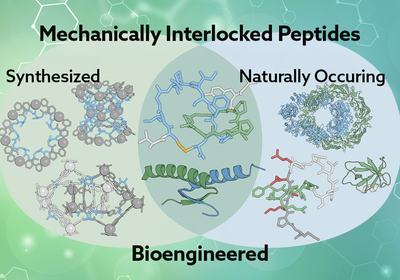
Mechanically interlocked peptides span lasso peptides, cysteine knots, and viral chainmail capsids, yet the fields studying them have run in parallel rather than together. A …
Siderophore Shape-Shifting
Hertweck Lab
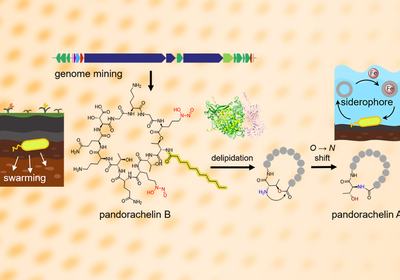
Bacteria rarely repurpose a single metabolite to serve two opposing ecological needs, yet that is precisely what Pandoraea species do with their pandorachelin lipopeptides: an …
Nucleolar Droplets On Demand
Department of Synthesis of Macromolecules at the Max Planck Institute for Polymer Research
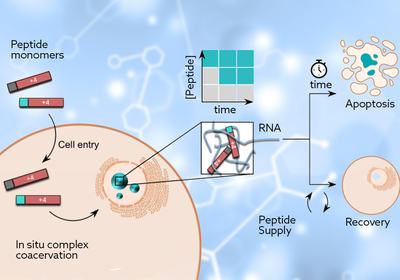
Synthetic coacervates that form inside living cells and then dissolve on command would open a new class of reversible compartments, but reaching the concentrations needed …
Tuning Integrin Selectivity
Wang and Hu Lab
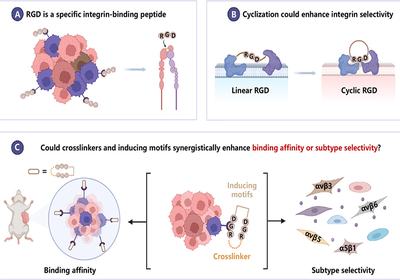
RGD peptides have long struggled to distinguish between closely related integrin subtypes, limiting their diagnostic precision. A new conformational tuning strategy, varying cross-linker length and …
Mining Biarylitides
Crüsemann and Cryle Groups
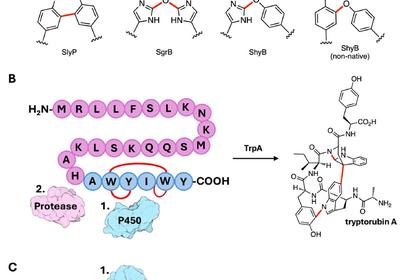
Biarylitides are bacterial RiPPs built from the smallest known genes in all of life, just 18 base pairs, making them nearly invisible to conventional genome …

Aldehyde Backbone Bending
Suga Lab
α-Amino-γ-lactam residues impose backbone constraints that can boost membrane permeability, yet no method existed for installing them post-translationally inside a display system. Now, an aldehyde-triggered …
Stapling With PMDA
Zhang and Li Groups
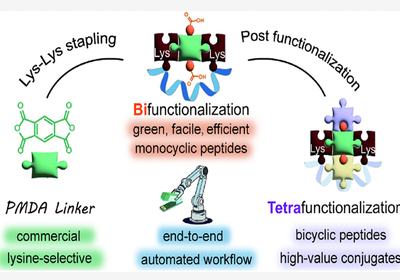
Peptide stapling typically demands exotic amino acids, cysteine handles, or metal catalysts, each carrying trade-offs in selectivity or modularity. A new pyromellitic dianhydride linker sidesteps …
Editing Lysine Radically
Arora Lab
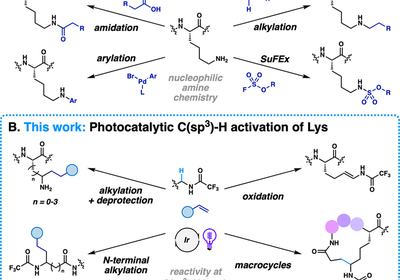
Lysine's aliphatic C–H bonds have long resisted selective functionalization, leaving a rich vein of branched unnatural amino acid motifs out of reach. A photoredox strategy …
Decoding HDAC Inhibitor Assembly
Challis & Alkhalaf Labs
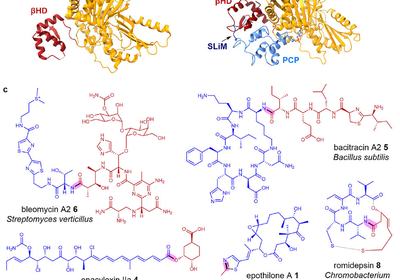
A family of depsipeptide HDAC inhibitors that includes the lymphoma drug romidepsin share a conserved pharmacophore fused to structurally diverse peptide caps, but the molecular …
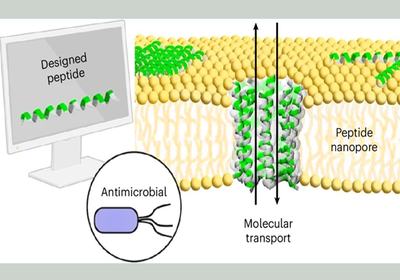
Pores by Design
Vácha Lab
Antibiotic-resistant bacteria are running out of places to hide. Researchers have now built a computational pipeline that designs synthetic peptides from scratch to punch stable, …
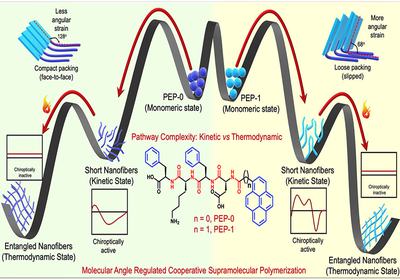
Angles Govern Assembly
Ghosh Lab
Adding a single methylene spacer between a pyrene chromophore and a tetrapeptide backbone shifts the molecular angle from 128° to 68°, flipping the π-stacking mode …
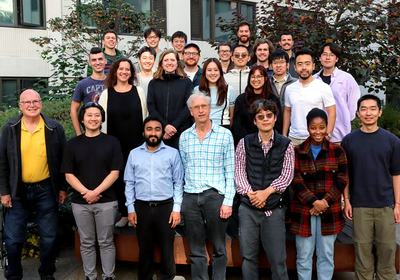
Protein Space Illuminated
DeGrado Lab
How often does a random sequence fold into a stable protein? Surprisingly often, if that sequence repeats itself. A large-scale computational survey of tandem-repeat proteins …
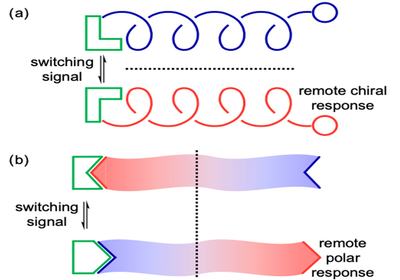
Foldamers in Membranes
Clayden Lab
Synthetic foldamers that switch their internal hydrogen-bond direction could one day carry signals across cell membranes, but only if their conformational dynamics survive the lipid …
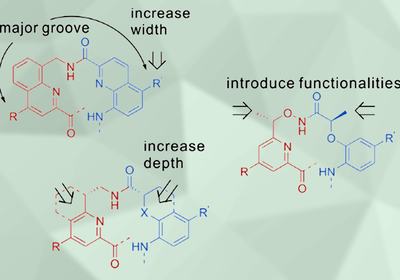
Groovy Foldamer Design
Huc Lab
Aromatic foldamers that mimic DNA can already outcompete the double helix for binding certain proteins, but their repetitive structure limits sequence-specific recognition. Now, four new …
Rethinking GPA Recognition
Davis Lab
Glycopeptide antibiotics are thought to work by gripping a single peptidoglycan motif through five hydrogen bonds. But when researchers simulated a recently discovered antibiotic that …
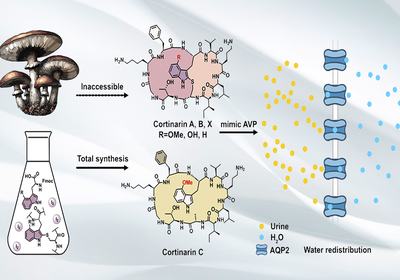
Mushroom Toxins Decoded
Süssmuth Lab
Cortinarins are bicyclic peptides from toxic Cortinarius mushrooms that have resisted independent biological study for decades. A new total synthesis now unlocks milligram quantities of …
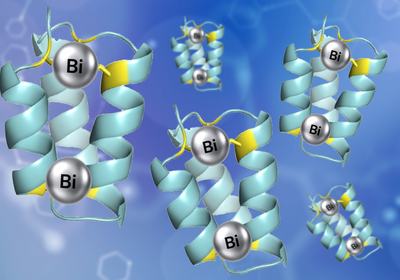
Bismuth Cyclisation Inside Living Cells
Jody Mason Lab
Cyclisation is one of the most dependable ways to make a peptide behave more like a drug, tightening its fold, sharpening target engagement, and slowing …
Tricycles from Display
Jongkees Lab
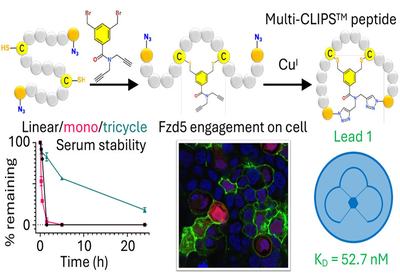
Tricyclic peptides offer tighter binding, better selectivity, and longer serum lifetimes than simpler macrocycles, but generating single regioisomers at the high dilution of mRNA display …
Questioning Cation–π
Gellman Lab
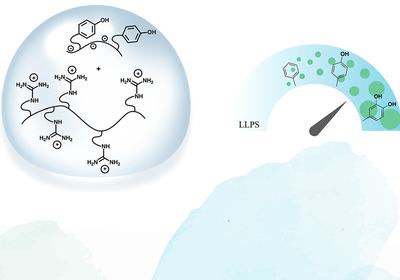
A long-held hypothesis holds that cation–π interactions between arginine and tyrosine side chains drive protein condensate formation. A new two-component model system built from a …
Phosphorylation Mimics Hydroxylation
Raines Lab
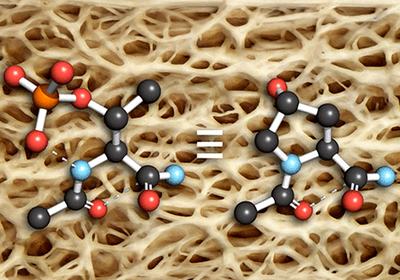
Collagen stability depends on 4-hydroxyproline, a permanent modification. Now, researchers show that phosphorylation of threonine at the Yaa position of a collagen triple helix mimics …
Coiled-Coil Grafting
Wilson, Woolfson, and Itzhaki Groups
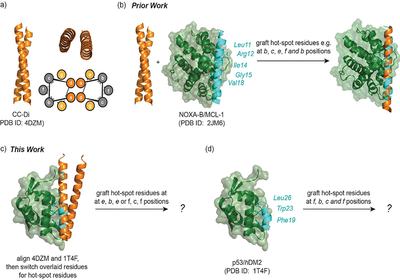
Protein–protein interactions are notoriously difficult to drug, but coiled-coil peptides offer a structured scaffold for presenting binding hot spots. Researchers grafted p53 hot-spot residues onto …
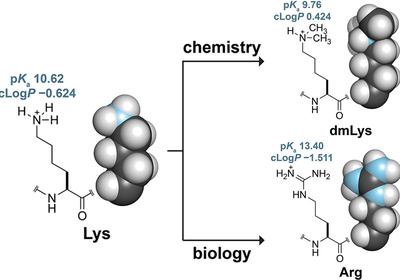
Methylating Every Lysine
Raines Lab
Replacing lysine with arginine is the standard move in protein engineering, but it changes charge geometry, alters hydrogen-bond donors, and cannot touch the N-terminal amino …
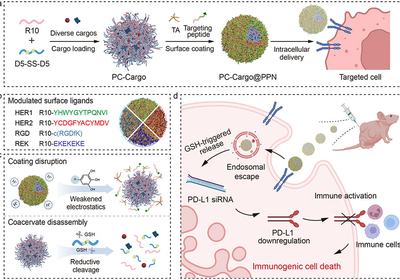
Coacervates Find Targets
Jiang, Caruso, and Liu Groups
Peptide coacervates are promising drug carriers, but poor stability and nonspecific uptake have limited their therapeutic reach. A new polyphenol–peptide network coating changes that equation, …
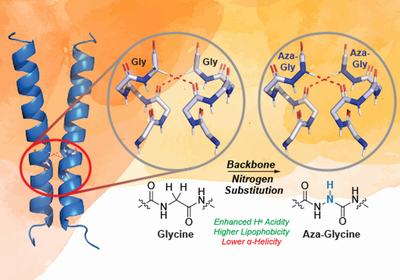
Probing GxxxG Interfaces
Newberry Lab
Glycine residues at GxxxG motifs stabilize transmembrane helix dimers through Cα–H hydrogen bonds, but their lack of side chains makes them difficult to engineer. Replacing …