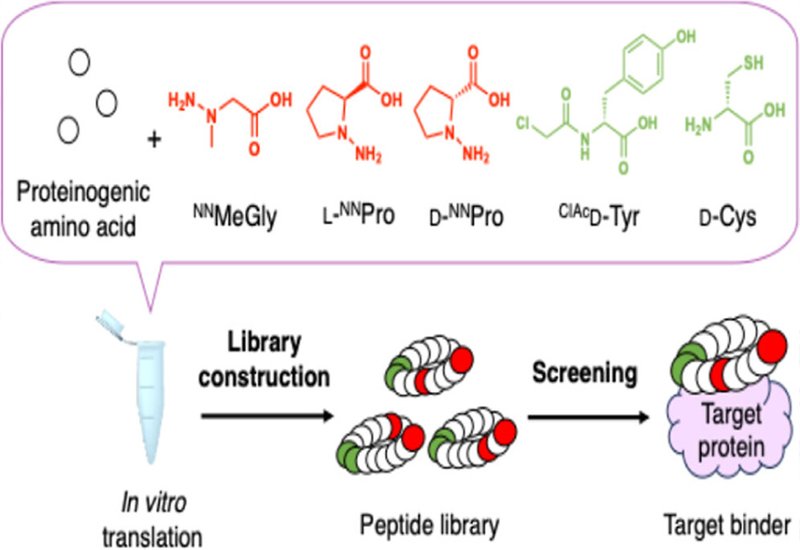
α-Hydrazino acids, α-Hzas, occupy an unusual structural niche among noncanonical amino acid building blocks. When incorporated into a peptide chain, the lone electron pair on the α-nitrogen forms a bifurcated hydrogen bond with adjacent amide groups, creating an eight-membered ring known as a hydrazino turn that rigidifies the overall scaffold. The hydrazidic bond linking an α-Hza to its upstream residue also confers proteolytic resistance, making these monomers attractive for therapeutic peptide design. Despite those advantages, no platform existed for selecting α-Hza-containing macrocycles de novo against proteins of interest, because ribosomal incorporation of backbone-altering amino acids is intrinsically inefficient and library construction had remained intractable.
Researchers in the Suga Group at The University of Tokyo, published in J. Am. Chem. Soc., constructed three mRNA-encoded macrocyclic peptide libraries incorporating three α-Hza building blocks: Nα-methylhydrazinoacetic acid, NNMeGly; L-hydrazinoproline, L-NNPro; and D-hydrazinoproline, D-NNPro. Efficient ribosomal incorporation relied on the engineered tRNA species tRNAPro1E2, which simultaneously recruits elongation factors EF-Tu and EF-P to overcome the kinetic barriers that normally limit backbone-altering monomer addition. Library A placed a single α-Hza at a fixed central position to enforce a turn; Library B placed α-Hzas randomly throughout a fully degenerate sequence; Library C focused on sequence motifs identified from Library B hits and encoded D-NNPro in a bridging region between two conserved binding motifs. All three libraries were subjected to the Random nonstandard Peptides Integrated Discovery, RaPID, selection against Janus kinase 2, JAK2, and human factor XIIa, FXIIa.
RaPID selection against JAK2 using Library B returned macrocycles BJ1 through BJ4. BJ3 and BJ4 bound JAK2 with dissociation constants of 0.24 nM and 1.0 nM respectively, and showed half-lives in human serum of 14 and 11 hours. Membrane permeability measured by the chloroalkane penetration assay revealed a sharp divergence: BJ3 achieved a CP50 of 2,500 nM, surpassing the known cell-penetrating peptide ct-Tat, whereas BJ4 showed limited permeability at 74,000 nM. Both peptides shared two sequence motifs, FYSRYD and DYX1X2P, that the team carried forward into Library C. The Library C campaign yielded CJ1 through CJ4, macrocycles in which D-NNPro occupies the linkage region between the two motifs. CJ1 through CJ4 maintained sub-nanomolar JAK2 affinity, with KD values of 0.44 to 1.3 nM, and serum half-lives of 7.7 to 18 hours. Compared with their Library B predecessors, the CJ series displayed association and dissociation rate constants roughly one order of magnitude slower, a kinetic profile consistent with D-NNPro enforcing a preorganized conformation that requires a more stringent fit upon binding and extends target residence time. CJ2 through CJ4 also showed high membrane permeability, with CP50 values of 730 to 1,900 nM, and reduced off-target binding to JAK1, JAK3, and TYK2 relative to BJ3 and BJ4.
Mutational studies substituting D-NNPro with β-alanine, (1S,2S)-2-aminocyclopentane carboxylic acid, AcpcS, (1S,2R)-Acpc, AcpcR, or L-proline in the CJ series and in the FXIIa-targeting macrocycles AF2 and AF3 revealed that D-NNPro is not functionally interchangeable. In CJ2 and CJ3, AcpcR substitution caused more than 500-fold reductions in affinity, whereas AcpcS caused less than 2-fold reductions, indicating that D-NNPro preferentially adopts a (1S,2S)-like configuration upon binding to JAK2. In CJ4, AF2, and AF3, even AcpcS failed to restore parent-level activity, pointing to an indispensable role for the α-nitrogen lone pair itself. Fragment-level proteolysis analysis showed that D-NNPro-bearing degradation products persisted for up to 72 hours, whereas the corresponding L-Pro mutant fragments were cleared within 24 hours. For FXIIa, AF2 and AF3, which share a DRRFzY motif, achieved IC50 values of 91 and 88 nM against the protease, consistent with their KD values of 61 and 23 nM. All amino acid substitutions at the D-NNPro position in AF2 and AF3 produced more than one order of magnitude weaker binding and inhibitory activity.
This work establishes α-Hza-containing macrocyclic libraries as a practical component of the RaPID platform and demonstrates that the hydrazino turn motif simultaneously improves binding kinetics, selectivity, proteolytic stability, and cell permeability in a single residue. The JAK2 inhibitors CJ2 through CJ4 outperform previously reported JAK2-inhibiting peptidomimetics by two to three orders of magnitude in affinity, providing a credible starting point for therapeutic development targeting autoimmune and inflammatory disease. The team also demonstrated that D-NNPro can substitute for cyclic β-amino acids in a 14-helical scaffold previously developed against the SARS-CoV-2 main protease, suggesting broader utility across peptide secondary structure types. Future work will explore α-Hzas carrying diverse substituents at the α-nitrogen and α-carbon to expand the accessible chemical space further.