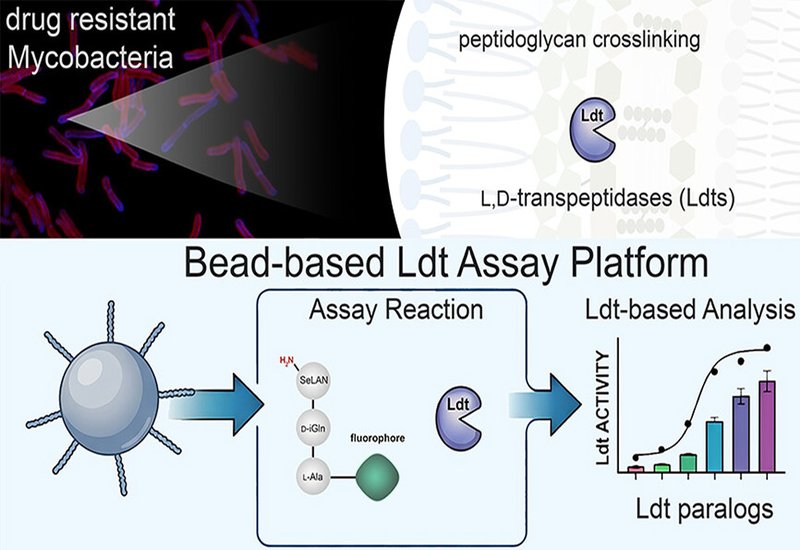
L,D-Transpeptidases, Ldts, cross-link the peptidoglycan cell wall of mycobacteria through a cysteine-based mechanism that builds 3→3 peptide bridges, distinct from the serine-dependent 4→3 cross-links made by classical penicillin-binding proteins. Because Ldts dominate cross-linking in Mycobacterium tuberculosis, they rank as high-value drug targets for tuberculosis, TB, a disease that claimed 1.23 million lives in 2024. It is laborious and low-yielding to synthesize meso-diaminopimelic acid, m-DAP, the third-position amino acid residue in mycobacterial stem peptides, which makes the substrates needed to study Ldt catalysis hard to build. Existing assays also struggle to separate the two steps of transpeptidation and to handle the structural heterogeneity of native peptidoglycan, limiting both mechanistic insight and screening throughput.
Researchers in the Pires Group at the University of Virginia, published in Biochemistry, met these limitations with a bead-based platform that reconstitutes both catalytic steps of Ldt activity using chemically defined substrates. The team immobilized a synthetic acyl-donor tetrapeptide bearing a propargyl group, tetAcK-yne, onto azide-functionalized polystyrene beads by copper-catalyzed azide-alkyne cycloaddition. These loaded beads were incubated with a fluorescent tripeptide acceptor, qSeDAPtri, which carries a selenium-based m-DAP surrogate at the third position, and a purified Ldt. If the Ldt cross-linked the fluorescent acceptor tripeptide, the increased fluorescence on the bead could be detected by flow cytometry. Inhibition of the active-site cysteine blocks cross-linking and lowers fluorescence proportionally, giving a ratiometric signal. The platform can be adapted to an antibody-based format, including ELISA on azide-functionalized microtiter plates.
After tuning reaction time, donor loading, acceptor concentration, and enzyme concentration with LdtMt2, the best-characterized Mtb Ldt, the team profiled all six Mycobacterium smegmatis paralogs, LdtA through LdtF. LdtA, LdtB, LdtE, and LdtF each gave fluorescence, confirming Ldt-dependent cross-linking, and the class 6 enzyme LdtF showed catalytic activity with purified peptidyl substrates for the first time. All Ldt activity could be inhibited by meropenem. The class 3 enzyme LdtD and the class 5 enzyme LdtC gave no detectable signal. Circular dichroism showed both are folded properly, so misfolding is ruled out. The authors propose a non-canonical role for LdtD, consistent with the absence of any reported 3→3 activity for class 3 Ldts, while LdtC, whose Mtb homolog does form 3→3 cross-links in vitro, may demand authentic m-DAP rather than the selenium surrogate.
Acyl-acceptor profiling with eight further analogs showed that LdtMt2 accepts trimeric substrates only with an m-DAP mimetic at the third position, requires amidation of iso-D-glutamic acid in tetrameric substrates, and tolerates pentameric variants carrying the third-position surrogate. Across the active M. smegmatis paralogs, third-position m-DAP mimetics were processed by LdtA, LdtB, LdtE, and LdtF, while only LdtA accepted a third-position lysine tetrapeptide. β-Lactam profiling in 96-well format, validated by a Z′ of 0.697, showed dose-dependent inhibition of LdtMt2 and the active paralogs by carbapenems and penems, including meropenem, faropenem, doripenem, biapenem, and tebipenem, whereas the cephalosporin ceftriaxone, the monobactam aztreonam, and the penam ampicillin were near-inert up to 20 μM.
By swapping heterogeneous sacculi preparations for chemically defined synthetic substrates on flow-cytometry-compatible beads, the platform clears a long-standing bottleneck in Ldt biology. Its dual compatibility with flow cytometry and antibody-based plate readers suits it to high-throughput screening against Ldts from both Mtb and nontuberculous mycobacteria, the first biochemical handle on a class 6 Ldt opens a previously inaccessible enzyme to inhibitor discovery, and the paralog-resolved inhibition profiles give a framework for selectivity-driven design. As carbapenem combinations draw renewed interest for drug-resistant TB, an assay that ranks candidates across the full paralog set should help speed the search for next-generation antimycobacterial agents.