Peptide Publications Archive
Showing items in Synthesis & Methodology · Clear filter
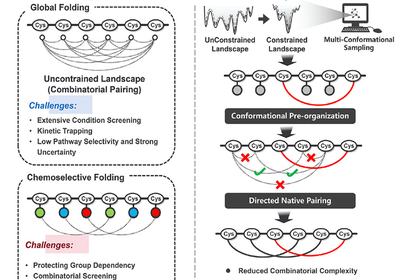
Folding by Design
Hemu Lab
Folding disulfide-rich peptides with three or more disulfide bonds has long frustrated chemists: without cellular machinery, the wrong bonds form first and kinetic traps accumulate. …
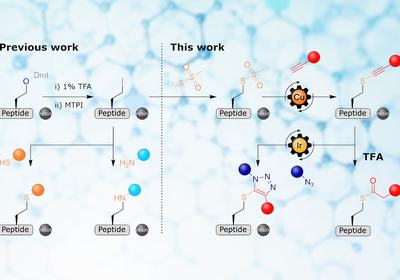
Dual Resin Clicks
Thomas Lab
Generating structurally diverse peptides on solid phase typically means modifying one site at a time, limiting how much chemical complexity a single sequence can carry. …
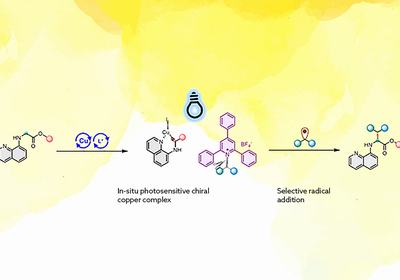
Deaminative UAA Synthesis
Singh Lab
Unnatural amino acids unlock drug-like peptides, but installing them with precise stereochemistry has resisted simple catalytic routes. A visible-light-driven copper catalyst now converts amine-derived Katritzky …
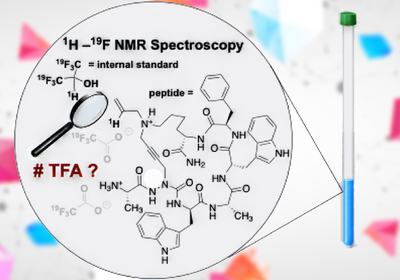
Weighing Without Weighing
Lubell Lab
Trifluoroacetic acid is ubiquitous in peptide synthesis and purification, yet quantifying how much remains in a final salt requires destroying the sample or trusting an …
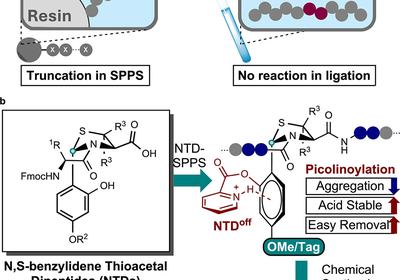
Shielding Thioacetals
Li Lab
Aggregation-prone proteins have long defeated chemical synthesis because the protecting groups needed to suppress aggregation could not survive the acid deprotection step. A picolinoylation strategy …

Greening Peptide Math
Albericio and De La Torre Lab
Peptide APIs carry some of the highest process mass intensity values in pharmaceuticals, yet most labs still skip the calculation entirely because the mass accounting …
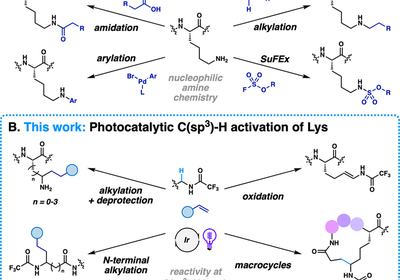
Editing Lysine Radically
Arora Lab
Lysine's aliphatic C–H bonds have long resisted selective functionalization, leaving a rich vein of branched unnatural amino acid motifs out of reach. A photoredox strategy …
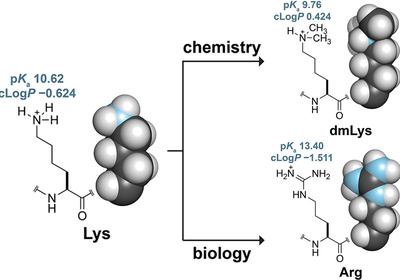
Methylating Every Lysine
Raines Lab
Replacing lysine with arginine is the standard move in protein engineering, but it changes charge geometry, alters hydrogen-bond donors, and cannot touch the N-terminal amino …
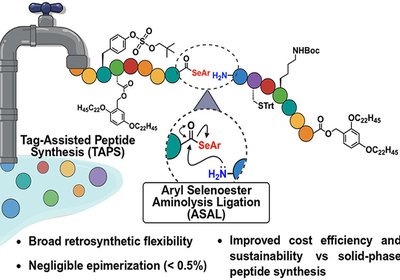
Greener Peptide Production
Payne Lab
Solid-phase peptide synthesis generates enormous chemical waste and struggles beyond roughly 50 residues. A new tag-assisted ligation strategy couples aryl selenoesters to side-chain-protected fragments in …
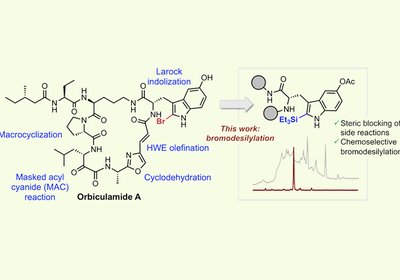
Taming Bromine
Perrin Lab
For 35 years, the marine macrocycle orbiculamide A resisted total synthesis, largely because its 2-bromo-5-hydroxytryptophan residue defeats every conventional bromination strategy. Now, a chemoselective late-stage …
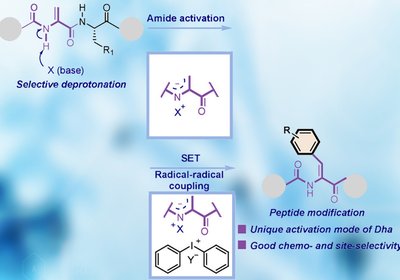
Activating Dehydroalanine
Liu and Wang Groups
A previously overlooked deprotonation of the dehydroalanine amide N–H unlocks selective arylation of peptides under mild conditions, with no metal catalyst required
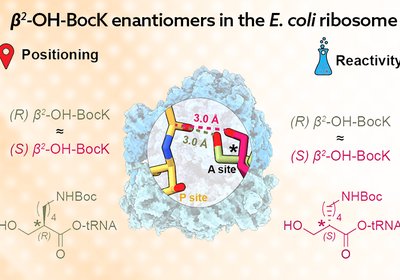
Ribosome Accepts Both
Cate & Schepartz Groups
Researchers in the Cate and Schepartz Groups at the University of California, Berkeley, and the Lawrence Berkeley National Laboratory, published in the Journal of the …
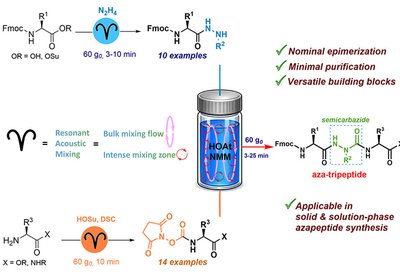
Scaling Azapeptides
Lubell Lab
A resonant acoustic mixing strategy solves long-standing problems in azapeptide synthesis, delivering scalable aza-tripeptide building blocks without epimerization, hydantoin formation, or chromatographic purification
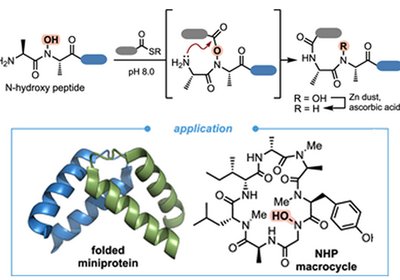
Backbone Bonds Unlocked
Del Valle Lab
A backbone hydroxamate group enables sequence-agnostic peptide ligation in water, bypassing thiolated amino acids and opening convergent routes to folded miniproteins and macrocyclic natural products
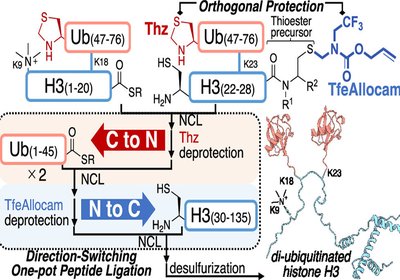
Switching Ligation Directions
Hayashi Lab
Researchers in the Hayashi, Murakami, and Okamoto Groups at Nagoya University and the University of Tokyo, published in the Journal of the American Chemical Society …

Templated Macrocycles
Wennemers Group
Researchers in the Wennemers Group at ETH Zürich, published in Science, developed a bifunctional tripeptide catalyst that templates head-to-tail macrocyclization through dual substrate engagement
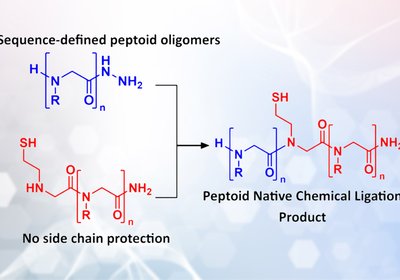
Peptoid Ligation
Kirshenbaum Group
Researchers adapt native chemical ligation to peptoid oligomers, enabling convergent synthesis of sequence-defined macromolecules and functional nanomaterials
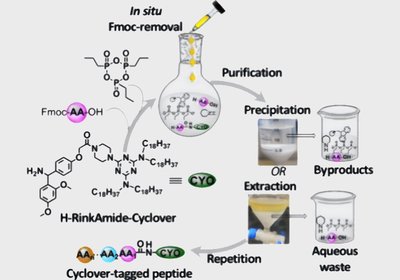
Greener Peptide Couplings
Albericio & de la Torre Group
Researchers in the Albericio & de la Torre Group at the University of KwaZulu-Natal, published in Organic Letters, introduced Cyclover as a commercially accessible …
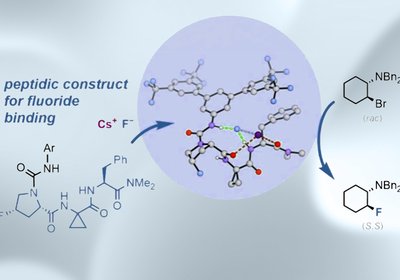
Peptides Deliver Fluoride
Gouverneur Lab
Fluorine is among the most consequential substituents in medicinal chemistry, improving metabolic stability, membrane permeability, and target binding across a broad range of drug candidates
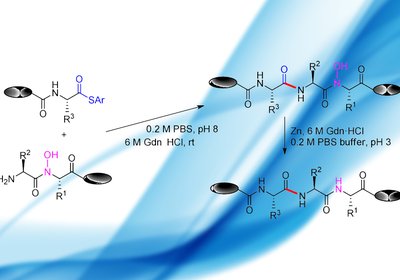
Site-Free Ligation
Hua Fu Lab
Researchers in the Fu Group at Tsinghua University in Beijing, published in Org. Lett., have developed a new chemoselective peptide ligation strategy, hydroxylamine-involved ligation, …
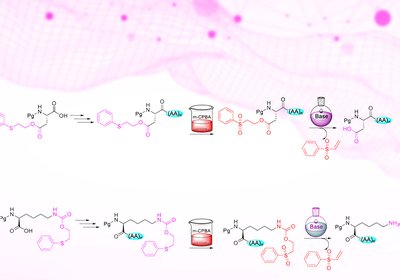
Safety Catch Strategy
Albericio Lab
Researchers supervised by Professor Fernando Albericio at the University of KwaZulu-Natal developed a new family of safety-catch protecting groups based on the phenylthioethyl, Pte, and …
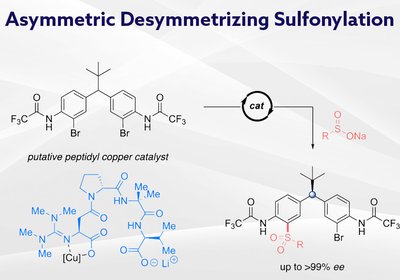
Remote Stereocontrol
Miller Lab
Researchers in the Miller Group at Yale University, published in the Journal of the American Chemical Society, have developed guanidinylated peptide ligands that enable …
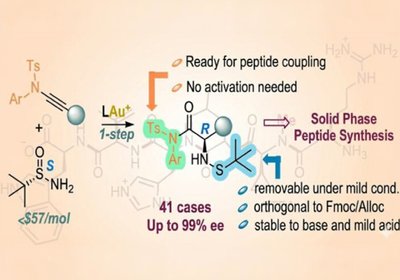
Ready-Made Amino Acids
Liming Zhang Lab
Researchers in the Zhang Group at the University of California, Santa Barbara, published in the Journal of the American Chemical Society, developed a concise …
Green Peptide Synthesis
Wellings, Meldal, and Wade Groups
Researchers supervised by Dr. Donald A. Wellings, Nobel Laureate Professor Morten Meldal, and Professor John D. Wade at the University of Melbourne, published in Nature …