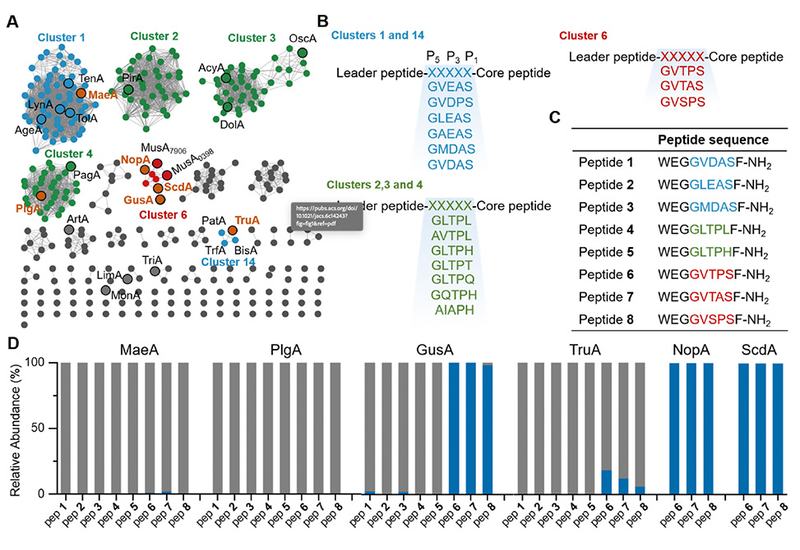
N-terminal processing proteases in cyanobactin biosynthetic pathways have received relatively little attention as engineering tools, despite their potential to influence pathway compatibility and library diversity. Part of the difficulty is structural: many characterized ribosomally synthesized and post-translationally modified peptide, RiPP, proteases require specific core peptide modifications before they will cleave, limiting broader applicability. A related problem is genomic: in well-established RiPP subclasses such as class III and IV lanthipeptides, cognate proteases are frequently not encoded within the biosynthetic gene clusters, making it difficult to connect a protease directly with its cognate precursor sequence. Engineering around these constraints tends to introduce trade-offs among catalytic efficiency, stability, and specificity that limit general applicability.
Researchers in the Liu Group at Sun Yat-Sen University and the Tsai Group at Shenzhen Bay Laboratory, published in the Journal of the American Chemical Society, addressed this problem by constructing a sequence similarity network of 351 N-terminal cyanobactin protease sequences and selecting representatives from distinct clusters for experimental characterization. GusA, from a cluster associated with linear cyanobactin biosynthesis, stood out: under identical conditions of 1 μM enzyme and 200 μM substrate at room temperature for 2 h, MaeA, PlgA, and TruA showed little to no detectable cleavage activity toward any of the tested substrates. GusA enforces strict recognition at P4 and P1 of the GVTPS motif, where even the S-to-T substitution eliminated detectable cleavage, yet tolerates most P1′ substitutions except the proline-containing substrate. Although the turnover rate is relatively modest, the low KM indicates strong substrate binding approximately 5- to 10-fold tighter than values typically reported for TEV protease.
The authors establish cyanobactin proteases as an underexplored source of sequence-selective biocatalysts for site-selective peptide and protein modification. GusA's combination of broad substrate tolerance and strict recognition-sequence selectivity opens routes to affinity tag removal from recombinant proteins, phage library construction via GusA-mediated N-terminal cysteine generation coupled to asymmetric bis-cysteine stapling, and multicolor cell-surface protein labeling orthogonal to TEV protease and enterokinase. Improved GusA variants are currently under development in the authors' laboratory.