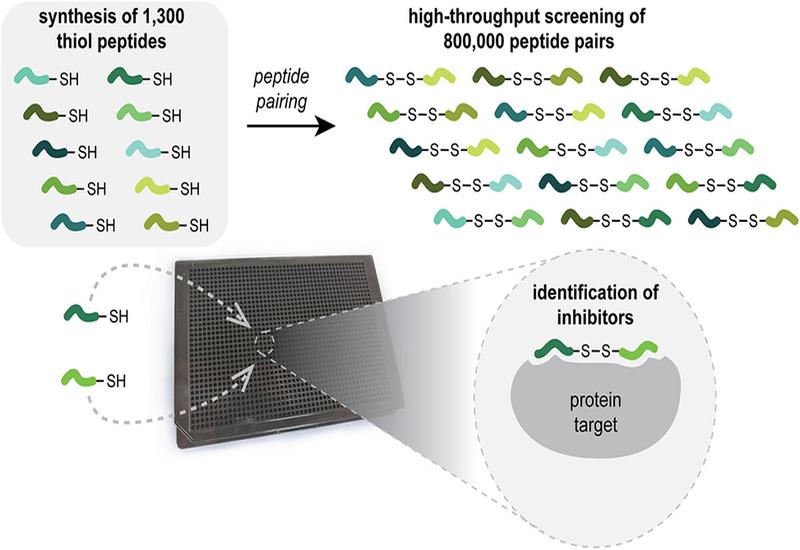
Functional screening of chemically synthesized peptide libraries has long faced a hard ceiling: high-throughput solid-phase peptide synthesis in 384-well plates can produce libraries, but their size is typically limited to a few thousand molecules. Affinity-selection methods can handle libraries exceeding a million compounds but introduce difficulties, including control of library quality and correct identification of binders. Biological display methods such as phage or mRNA display reach over a billion peptides, yet cannot readily accommodate the structurally and chemically diverse non-canonical building blocks that chemical synthesis affords. The result is a gap between what chemists can make and what they can screen at scale, with meaningful consequences for challenging targets that lack well-defined small-molecule binding pockets.
Researchers in the Heinis Group at the École Polytechnique Fédérale de Lausanne, published in Angewandte Chemie International Edition, addressed this gap by combinatorially pairing short thiol-bearing peptides via disulfide bond formation: m peptides combined with n peptides of the same format yield m × n distinct sequences without requiring individual full-length synthesis of each compound. Acoustic liquid transfer moves nanoliter volumes into 1536-well plates, and dimerization proceeds in a 1:1 DMSO/ammonium bicarbonate buffer. Reliance on two thiol groups means homodimeric side products form alongside the desired heterodimers, a limitation the authors note could in principle be addressed by orthogonal reactive groups. Together, the approach enabled screening of around 800 000 chemically synthesized peptide compounds, a number the authors attribute in part to the loss of one microtiter plate during the Library 2 screening process, yielding nanomolar inhibitors of the coagulation protease thrombin.
The strategy extends in principle to other targets, and full inhibition data, selectivity profiles, and structural analysis of the most potent hits are reported in the original publication.