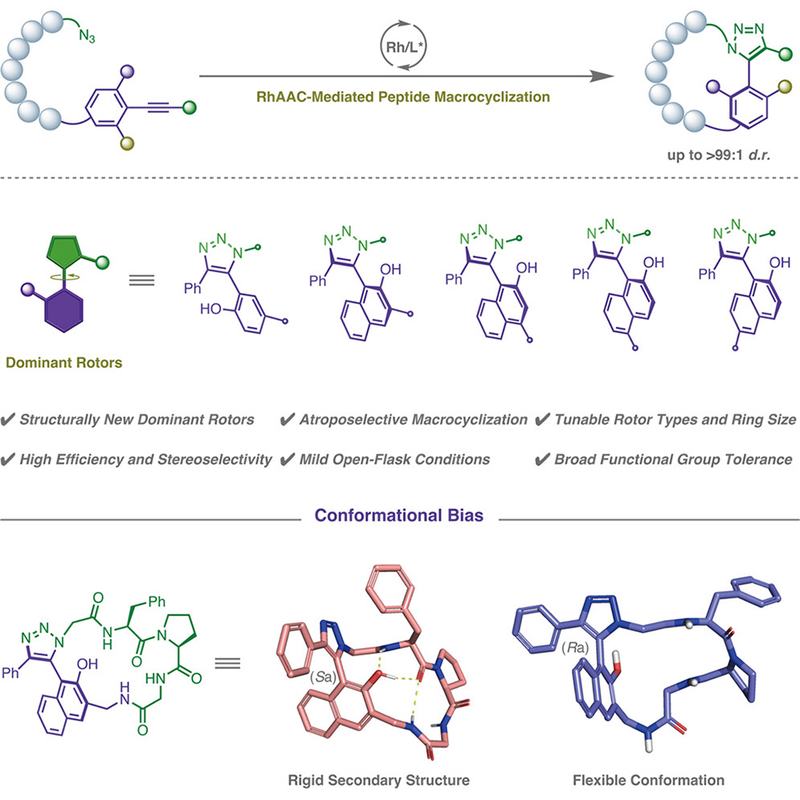
Macrocyclic peptides are valued because they can adopt defined three-dimensional shapes, yet enforcing that definition is difficult. Backbone torsions interconvert freely, and conformational heterogeneity blurs the structural identity of the ring. One strategy to overcome this is the dominant rotor: a biaryl unit whose rotational barrier so far exceeds those of the other backbone torsions that it reorganizes the conformational energy landscape into two isolable atropisomeric states, each with its own distinct conformational ensemble. Installing such a rotor with controlled axial chirality during macrocyclization would allow stereochemically programmed conformational control, but the challenge had resisted solution. Competing transannular interactions limit stereochemical discrimination during ring closure, and achieving atroposelective control in backbones carrying multiple amide bonds and Lewis base residues is further complicated by potential catalyst perturbation and competing coordination events.
Researchers in the Yudin Group at the University of Toronto and the Spring Group at the University of Cambridge, published in Chem, report a catalytic atroposelective macrocyclization strategy that constructs dominant rotors in macrocyclic peptides via intramolecular rhodium-catalyzed azide-alkyne cycloaddition, RhAAC. The cycloaddition forges a triazole-based biaryl whose rotational barrier can exceed 30 kcal·mol−1, well above the 25 kcal·mol−1 threshold that defines a dominant rotor, and the axis born at that step carries the axial chirality of the product. A key design constraint emerged early: when the ortho-substituent was a hydrogen atom, the triazole biaryl underwent atropisomeric interconversion on the NMR timescale, confirming that sufficient steric bulk is required to clear the dominant-rotor threshold. Pairing [Rh(cod)(OH)]2 with the (S)-Carreira phosphoramidite ligand delivered the major atropisomer in 89% isolated yield at 97:3 diastereomeric ratio; switching to the (R)-Carreira ligand reversed atroposelectivity, affording a 45:55 dr.
The authors describe the platform as offering significant potential for peptide-based therapeutics with well-defined three-dimensional architectures, while noting that therapeutic activity itself remains to be demonstrated. Plasma stability assays showed that atropisomeric macrocycles remained intact over 7 days in human plasma, whereas the linear precursor was largely consumed within 120 hours. The full substrate scope, conformational analyses, and mechanistic discussion are reported in the original publication.