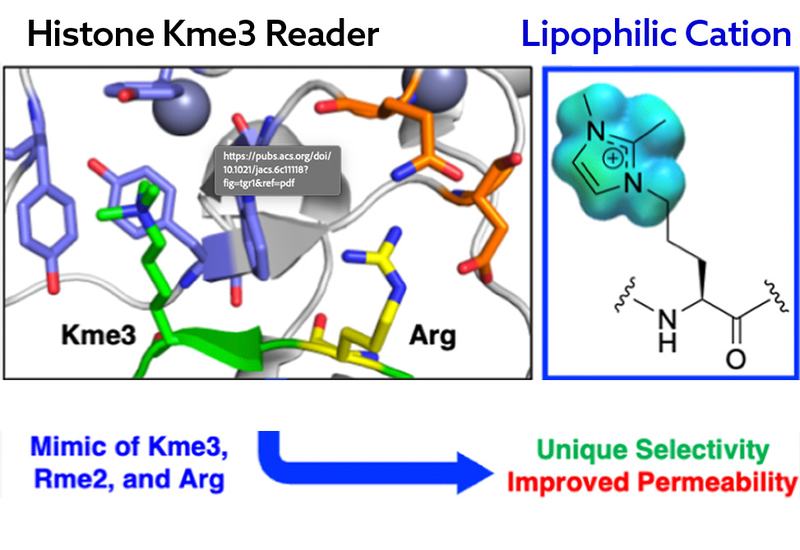
Histone trimethyllysine, Kme3, reader proteins are compelling therapeutic targets in cancer, yet they have proven stubbornly difficult to inhibit with cell-penetrant molecules. The binding interface is shallow, solvent-exposed, and cooperative: high affinity requires not only a cationic Kme3 mimic nestled in an aromatic cage, but often a neighboring arginine residue as well. Every additional positive charge improves binding and worsens membrane permeability, creating a design conflict that has stalled peptidomimetic probe development for this entire protein class for years. Neutral isosteres such as tert-butylnorleucine sidestep the charge problem but surrender the electrostatic interactions that most reader aromatic cages require. The field has lacked cationic mimics lipophilic enough to cross cell membranes without abandoning the charge.
Dr. Uttam Ghosh and colleagues in the Marcey Waters Lab at the University of North Carolina at Chapel Hill, published in J. Am. Chem. Soc., reasoned that imidazolium amino acids, IAAs, could resolve this conflict by replacing the localized, hydrogen-bond-donating charges of Kme3 and arginine with a more dispersed, lipophilic cation that retains the capacity for cation–π and π–π interactions with aromatic cage residues. The team synthesized three Fmoc-protected IAAs: an unsubstituted imidazolium (X1), a 2-methylimidazolium (X2), and a benzimidazolium (X3), each placing the imidazolium C2 at the ζ-position equivalent to the ammonium nitrogen of Kme3. Binding tolerance across a panel of plant homeodomain, chromodomain, tandem Tudor, and CW reader proteins proved to be governed by the geometry and openness of the aromatic cage rather than by neutral-isostere tolerance, giving the IAAs a selectivity profile distinct from any previously reported Kme3 mimic. Most consequentially, X2 binds the MORC3 CW domain more tightly than the native Kme3 ligand, and IAA-containing analogs of the CBX7 inhibitor UNC3866 achieved cytosolic penetration at least threefold more favorable than the parent compound via the chloroalkane penetration assay.
IAAs that simultaneously match or exceed native binding affinity while improving cell penetration offer a practical route past the charge-permeability impasse that has constrained epigenetic chemical biology. The selectivity differences observed across structurally related reader proteins suggest further opportunities for probe development targeting specific oncogenic readers, and the authors note that the lipophilic cation strategy may generalize to any protein–protein interaction anchored by cationic residues. Full binding data, X-ray crystallographic analysis of the BPTF PHD–X3 complex, and cellular reporter assay results are available in the original publication.