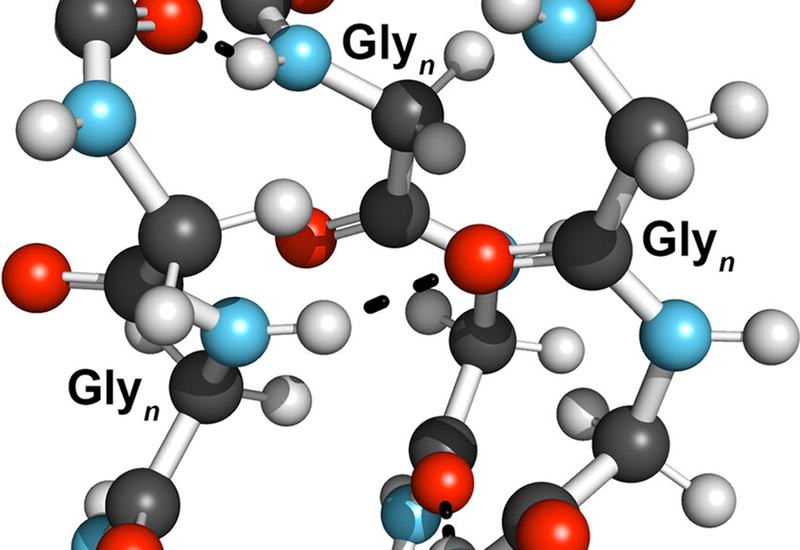
The collagen triple helix is the most abundant protein structural motif in animals, and its architecture imposes one absolute rule: glycine at every third position. Nature surrounds those glycines with (2S)-proline and (2S,4R)-4-hydroxyproline, Hyp, not because the geometry demands it but because these pyrrolidine-containing residues preorganize each strand into the polyproline II conformation, paying the entropic cost of folding in advance. Remove Pro and Hyp and the conformational freedom of the remaining residues was thought to make triple-helix formation prohibitively costly. Yet glycine is not conformationally indifferent: crystallographic and solution studies show that polyglycine populates an extended, left-handed helical conformation closely related to the polyproline II helix, and the torsion angles it prefers sit within the collagen-compatible region of conformational space. The question, long unanswered, is whether the triple-helical architecture is intrinsically stable or merely the product of Pro/Hyp preorganization.
Researchers in the Raines Lab at the Massachusetts Institute of Technology, writing in Biopolymers, designed collagen-mimetic peptides to settle the question without fighting entropic gravity directly. Rather than attempting to fold three free polyglycine chains from solution, they flanked a central Gly6 tract with (Pro-Hyp-Gly)n clamps on both sides. The clamps self-assemble into a triple helix, hold all three Gly6 segments in register and proximity, and thereby supply the entropic subsidy that free polyglycine strands cannot provide for themselves. A matched control replaced the Gly6 tract with a flexible, length-matched spacer that preserves the clamp architecture but lacks the regularly spaced amide donors and carbonyl acceptors of a polyglycine backbone. Circular dichroism and thermal denaturation data show that the polyglycine tract contributes to the triple-helical signal on a per-residue basis comparable to the clamp residues, and raises the apparent melting temperature relative to the spacer control, consistent with active stabilization via interstrand hydrogen bonds rather than mere passive accommodation.
For peptide design, a polyglycine core creates blunt, symmetric triple-helical termini amenable to end-on functionalization, opening a class of minimalist, conformationally defined scaffolds. For evolutionary biology, the finding supports a model in which the triple-helical fold predates the recruitment of l-proline and its post-translational hydroxylation, consistent with a glycine-rich ancestral collagen on an early Earth. Full spectroscopic data, thermal denaturation curves, and comparisons across all peptide variants are presented in the original publication.