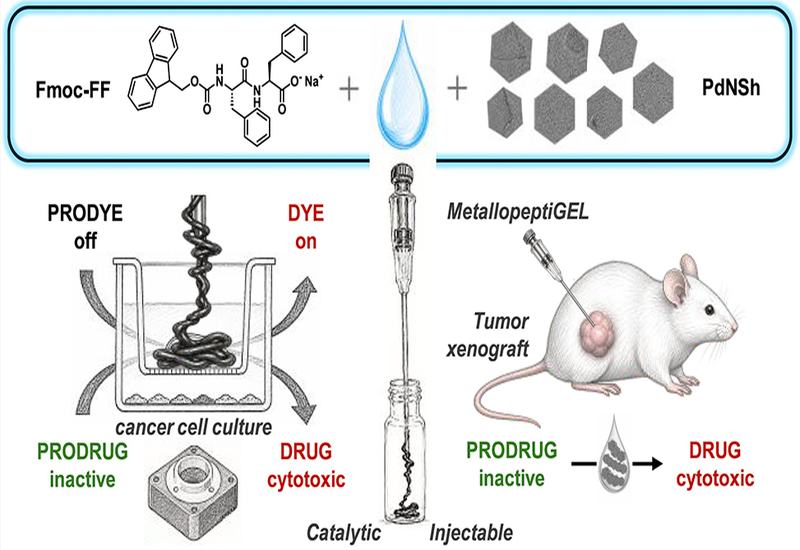
Bioorthogonal catalysis offers a compelling strategy for cancer therapy: place a metal catalyst in a tumor, administer an inert prodrug systemically, and let the catalyst convert it to an active drug only at the disease site. Realizing this as a practical injectable material has proved difficult. Earlier proof-of-concept systems using natural or nonbiodegradable gelling agents to immobilize metal nanoparticles could not progress to animal studies because of poor mechanical properties and limited catalytic durability. Triggering peptide self-assembly by modifying media conditions is not optimal for therapeutic use, because the gel could be susceptible to chemical variations across the tumor tissue. No material had yet combined all of these requirements.
Researchers in the Sebastian Group at the Instituto de Nanociencia y Materiales de Aragon, CSIC−University of Zaragoza, the Álvarez de Cienfuegos Group at Universidad de Granada, and the Unciti-Broceta Group at the University of Edinburgh, published in Journal of the American Chemical Society, speculated whether a palladium catalyst could itself trigger peptide gel formation, bypassing external media changes. Mixing an alkaline Fmoc-FF solution with ultrathin palladium nanosheets, PdNSh, instantly produced a soft gel the team named metallopeptiGEL. Computational studies suggest Fmoc-FF adheres to PdNSh surfaces through aromatic interactions; the simulations further indicate Fmoc-FF molecules may occupy the internanosheet space by forming supramolecular chains extending from both surfaces. In a BxPC-3 pancreatic cancer xenograft in mice, metallopeptiGELs demonstrated anticancer efficacy only when both the catalyst and the prodrug precursor were administered.
The authors describe metallopeptiGELs as, to the best of their knowledge, the first injectable catalytic gel of its kind, and state that this work opens a new direction for bioorthogonal therapies. In a BxPC-3 pancreatic cancer xenograft model in mice, anticancer efficacy was observed only when both the catalyst and the prodrug precursor diPro-5FU were administered together, with the most prominent effect appearing after the third treatment cycle. The full mechanistic data, biodistribution analysis, and in vivo results are available in the original publication.