Fluorinated Core Evolution

Reflecting work in the Suga Lab

Published here October 21, 2026

In Vitro Selection of Functional Neoproteins Containing Highly Fluorinated Cores

Adam Beattie, Alexander Vinogradov, Chikako Okada, Toru Sengoku, Takayuki Katoh, Hiroaki Suga

Angewandte Chemie International Edition 2026, e5293145. https://doi.org/10.1002/anie.5293145

View Original Publication


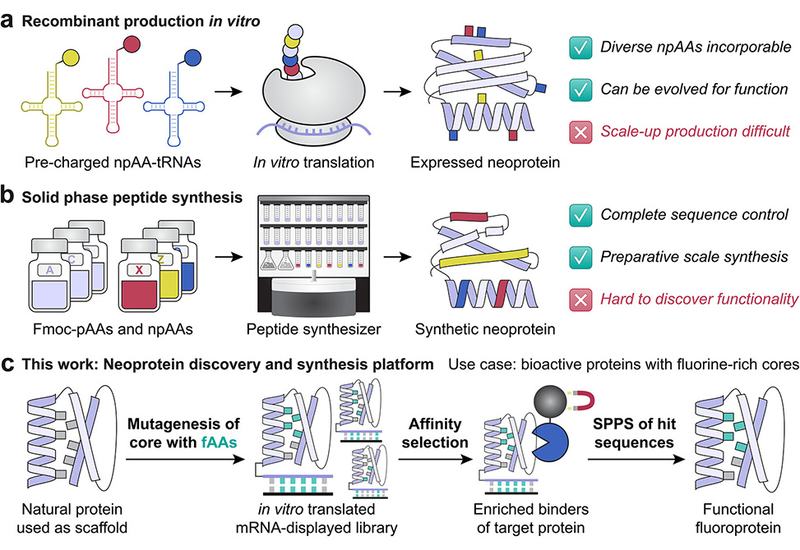
Fluorinated amino acids, fAAs, have long attracted interest as non-proteinogenic building blocks that can tune protein stability and introduce 19F NMR handles, but deploying them inside a folded protein's hydrophobic core while preserving function has proven difficult. Replacing core residues with fluorinated analogues changes sidechain volume and polarity simultaneously, and it remained unknown how far a natural core could be repacked with unnatural sidechains before activity collapsed. The combinatorial problem compounds the difficulty: protein sequence space is vast, and experimental screening methods generally lack the throughput to sample all possible permutations of fAA incorporation across even a handful of positions. Genetic code reprogramming combined with mRNA display offers the required throughput in principle, yet prior to this work those methods had not been applied to evolve fAA-containing folded proteins with a defined biological activity.

Researchers in the Suga Group at The University of Tokyo, published in Angewandte Chemie International Edition, addressed this gap with a two-step platform combining genetic code reprogramming, mRNA display-based in vitro selection, and microwave-assisted solid-phase peptide synthesis. The flexible in vitro translation system FIT loaded six chemically distinct fluorinated non-proteinogenic amino acids into a randomized library based on chymotrypsin inhibitor 2, CI2, from barley; mRNA display then selected variants that inhibit chymotrypsin with nanomolar potency, with several more active than the wildtype and thermostabilities of up to 70 °C. The selection is agnostic to the precise structure of variants, so non-native folds could in principle be enriched, and the platform was validated using only CI2 as scaffold and chymotrypsin as target. The hits contain, to the authors' knowledge, the most site-specific fAA incorporations of any genetically encoded sequence with a defined protein fold.

The work demonstrates that substantially remodeling the structural core of a natural protein with non-proteinogenic amino acids need not erase its function, and the authors anticipate the platform will provide a foundation for de novo design of neoproteins with diverse functionalities.
Author

Alexander A. Vinogradov, Ph.D., earned his Specialist degree in chemistry from Lomonosov Moscow State University, Russia, under Professor Nikolay Zyk. He pursued his Ph.D. at the Massachusetts Institute of Technology under Professor Bradley Pentelute, where his research advanced rapid, flow-based chemical synthesis of peptides and synthetic proteins. Vinogradov then joined the laboratory of Professor Hiroaki Suga at the University of Tokyo, developing methods that combine mRNA display, ribosomal synthesis, and deep learning to profile peptide post-translational modification enzymes and to discover natural product-like macrocyclic peptides. In December 2024, he established his own research group in the Department of Pharmacy and Pharmaceutical Sciences at the National University of Singapore. His current work spans chemical biology, enzymology, drug discovery, and AI.

Author

Hiroaki Suga, Ph.D., earned his B.Eng. and M.Eng. from Okayama University, Japan, and his Ph.D. in chemistry from the Massachusetts Institute of Technology under Professor Satoru Masamune. After postdoctoral work with Professor Jack Szostak at Massachusetts General Hospital/Harvard Medical School, he began his independent career at the State University of New York at Buffalo in 1997 and moved to the University of Tokyo in 2003, where he has been Professor of Chemistry in the Graduate School of Science since 2010. Suga invented the flexizyme, an artificial ribozyme that charges tRNAs with nonproteinogenic amino acids, and combined it with reconstituted in vitro translation and mRNA display to create the RaPID system for discovering macrocyclic peptides against challenging protein targets. He is an academic founder of PeptiDream and MiraBiologics, and his honors include the Vincent du Vigneaud Award, 2019, the Wolf Prize in Chemistry, 2023, and the Japan Academy Prize, 2024.

Fluorinated Core Evolution

Dr. Adam Beattie is a postdoctoral researcher at the Department of Chemistry of the University of Tokyo. He completed his Ph.D. under the supervision of Professor Hiroaki Suga at the University of Tokyo, where he worked on developing non-standard proteins using genetic code reprogramming and mRNA display-based in vitro selection.