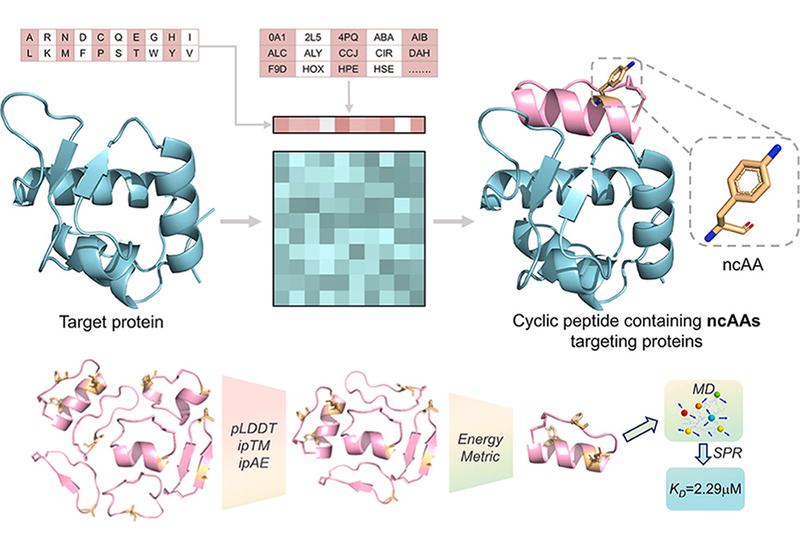
Cyclic peptides occupy a productive middle ground between small molecules and biologics: they can span large, shallow protein surfaces that small molecules cannot engage, while remaining far more synthetically tractable than antibodies. Incorporating non-canonical amino acids, ncAAs, into these macrocycles promises additional gains in shape complementarity, metabolic stability, and chemical diversity, but it comes at a steep computational cost. Because ncAAs lack the single-letter encoding of the standard twenty residues, their three-dimensional atomic topologies must be explicitly parameterized before any structure predictor can handle them. The resulting design space balloons to a size that makes conventional search strategies slow and inconsistent. The absence of end-to-end workflows that treat ncAAs as native design variables throughout a structure-guided optimization loop has been the central bottleneck holding back this class of candidates.
Researchers in the Duan Lab at Macao Polytechnic University and the Wang Lab at Zhejiang University of Technology, published in European Journal of Medicinal Chemistry, developed HighPlay2 to close that gap. The framework extends an earlier Monte Carlo Tree Search platform in three coordinated directions. First, it encodes sixty commercially available ncAAs through their Chemical Component Dictionary three-letter codes, allowing the Boltz-2 co-folding engine to retrieve atomic composition, bonding connectivity, and stereochemistry directly from the PDB dictionary rather than falling back to canonical-residue approximations. Second, a variable-length mutation mechanism represents sequences at a fixed maximum length with a blank token marking empty positions, so residue addition and deletion become simple site-value updates within a unified action space. Third, candidate evaluation relies on a Structure-Constrained Objective Score, SCOS, that fuses structure-prediction confidence terms with hotspot-geometry constraints, functioning as a selection filter rather than a binding-affinity predictor. This multi-stage funnel narrows thousands of generated sequences to a handful of candidates ready for Rosetta interface analysis, molecular dynamics simulation, and surface plasmon resonance testing. Applying the workflow to the MDM2 target, the tightest binder carried a phosphoserine residue that formed a persistent salt bridge with Arg96 throughout a microsecond simulation.
HighPlay2 demonstrates that chemically explicit ncAA representation, structure-guided scoring, and tree-search optimization can combine into a practical early-stage design pipeline for macrocycles that go well beyond the standard amino acid alphabet. github.com/hongliangduan/HighPlay2. The framework is openly available on GitHub. For peptide chemists working at the frontier of macrocycle drug discovery, the full experimental characterization, computational benchmarks, and workflow details are available in the original publication.