Tyrosine-selective chemistry has built up a substantial reaction repertoire over the past decade, yet a persistent gap has limited its utility in drug discovery: integrating modular tyrosine modification with macrocycle-library construction and genetically encoded selection remained, as the field acknowledged, largely unexplored. Francis and co-workers established that tyrosinase could oxidize solvent-exposed terminal tyrosine tags on peptides and proteins, enabling site-selective conjugation with aniline derivatives. Wang and co-workers later extended tyrosinase-mediated coupling to intramolecular peptide stapling in predefined sequences. What neither approach addressed was the use of this chemistry as a modular diversification strategy for randomized peptide libraries, leaving a clear opening between residue-selective modification and discovery-oriented screening.
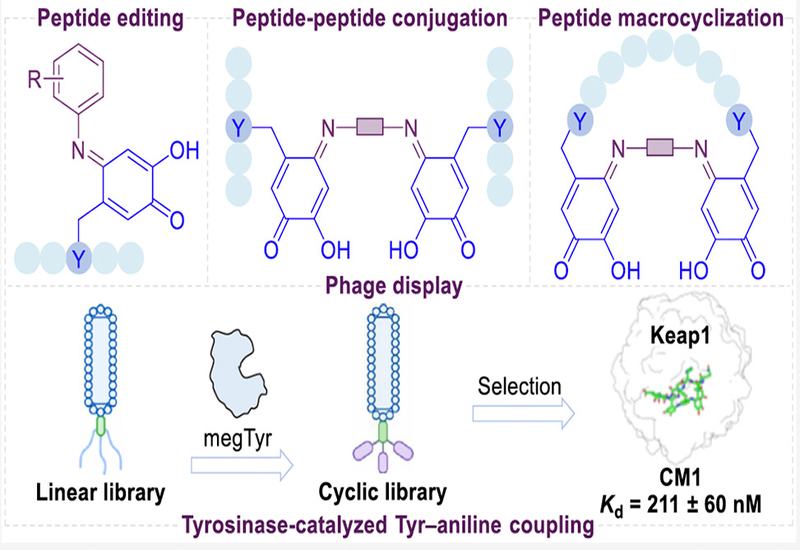
Researchers in the Lei Group at Lanzhou University, published in the Journal of the American Chemical Society, report a tyrosinase-catalyzed tyrosine-aniline coupling platform that unifies peptide macrocyclization and phage-display-based ligand discovery within a single reaction manifold. Based on prior studies, megTyr selectively oxidizes accessible tyrosine residues to o-quinone intermediates, which couple with arylamine nucleophiles under aqueous conditions at room temperature; under optimized conditions in PBS at pH 6.5, conversion approached completion within 3 minutes, though results may not transfer to other buffers, pH values, or temperatures. Bifunctional phenylenediamine linkers extend this chemistry intramolecularly to close macrocycles, and the key advance is translating this single-step cyclization directly onto phage: a monovalent M13 platform, chosen to minimize potential avidity effects, presents tyrosine-flanked randomized peptides as pIII fusions, allowing p-phenylenediamine with catalytic megTyr to macrocyclize an entire library in one treatment.
Applied to Keap1 biopanning, four rounds of selection enriched cyclic peptide CM1, which bound Keap1 with a KD of 211 ± 60 nM by SPR and showed a half-life of 5 hours in 100% mouse plasma compared to less than 30 minutes for its linear precursor. An independent campaign against EphA4 yielded a second cyclic binder, supporting, as the authors state, "the applicability of the platform beyond a single-target system," though the two-target demonstration leaves broader generalizability to future work.