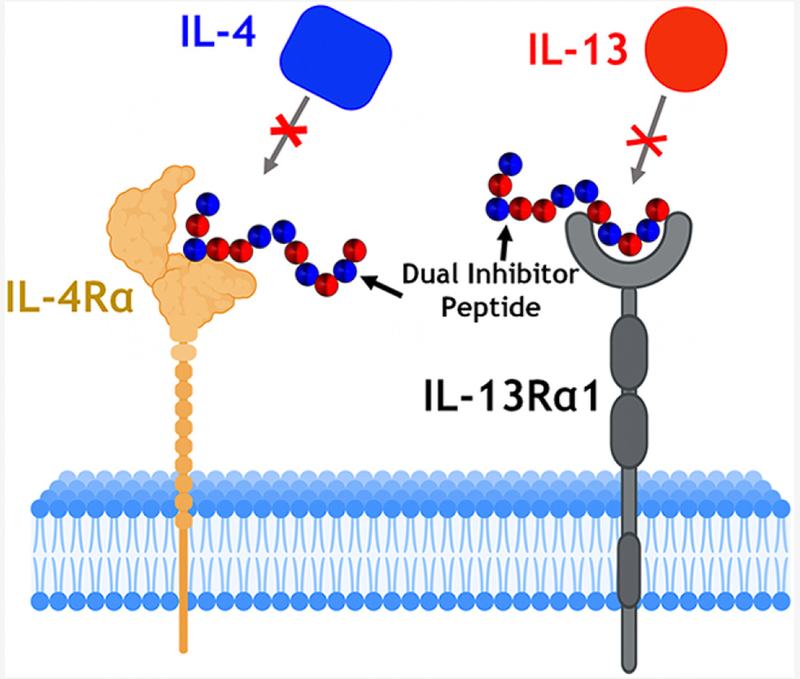
Blocking IL-4 and IL-13 signaling simultaneously is an attractive therapeutic goal in allergic and atopic disease, yet the two cytokines engage overlapping but structurally distinct receptor interfaces: IL-4 receptor α, IL-4Rα, and IL-13 receptor α1, IL-13Rα1. Monoclonal antibodies can span both targets but carry a molecular weight near 150 kDa, limited tissue penetration, and complex manufacturing demands. Small molecules struggle to engage the extended, topologically complex interfaces that cytokine-receptor assembly requires. Peptide discovery campaigns typically yield ligands selective for a single target, and encoding dual-recognition into a single scaffold at the screening stage, rather than grafting it on later, remained an open design problem.
Researchers in the Fetse Group at the State University of New York at Binghamton, published in ACS Medicinal Chemistry Letters, addressed this by running an alternating phage display biopanning campaign in which sequential selection rounds cycled between IL-4Rα and IL-13Rα1, enriching for clones with affinity for both receptor interfaces simultaneously. Lead peptide FMI-15 inhibited IL-4/IL-4Rα and IL-13/IL-13Rα1 interactions with IC50 values of 7.98 and 3.13 μM and suppressed both cytokine-induced signaling in cell-based reporter assays with EC50 values of 25.1 and 31.6 μM, respectively. The authors frame FMI-15 as an initial dual-targeting scaffold whose potency values are typical of native linear peptides and indicate the need for further optimization.
The work establishes alternating phage display as a strategy for encoding dual-target recognition at the discovery stage, bypassing the need for post-hoc engineering. Full binding data, simulation trajectories, and the complete structure-activity analysis are available in the original publication.