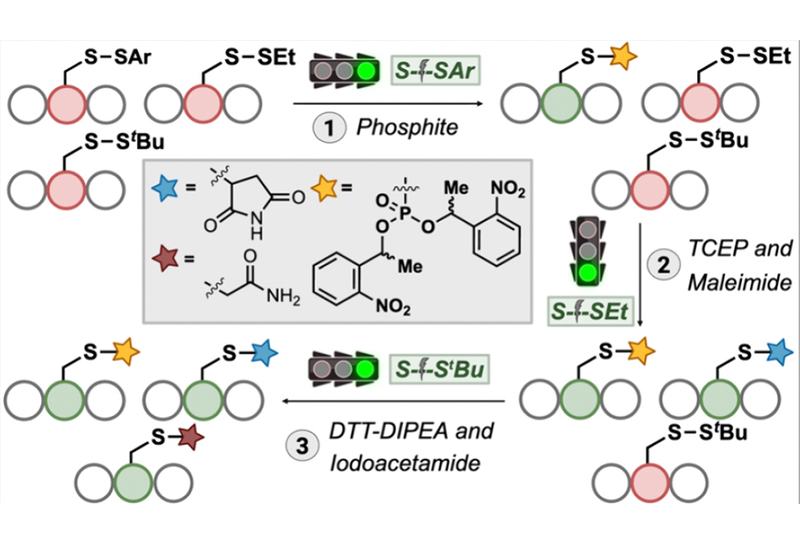
Disulfide bonds govern peptide folding, stability, and bioactivity, yet the standard toolkit for modifying them treats every S−S linkage as chemically identical. Global reduction to free thiols opens the way to derivatization and erases the individual identity of each disulfide along with it, so site-selective editing of a multi-disulfide scaffold has depended on orthogonal protecting groups installed during synthesis. Those routes serve when the plan is set from the outset, but they offer nothing for a peptide already in hand. Late-stage diversification of fully unprotected, pre-formed peptides has stayed out of reach, narrowing access to disulfide-rich conjugates, probes, and therapeutic candidates.
Researchers in the Raj Group at Emory University, published in Organic Letters, asked whether the disulfide bond itself could supply the selectivity, replacing external protecting groups with intrinsic chemical architecture. Aromatic (S−SAr), ethyl (S−SEt), and tert-butyl (S−StBu) disulfides differ in steric bulk and in the polarization of the S−S bond, and the group reasoned that those differences should produce characteristic activation profiles, each addressable by a matched reagent. A screen of common reductants against model substrates returned an operational hierarchy in which every architecture responds to its own activation mode while the other two remain intact. Run in order, the hierarchy supported sequential installation of three different functional groups across a mixture of fully unprotected peptides carrying all three linkages alongside Lys, Tyr, Met, and Trp, with no detectable modification of those side chains. Aromatic disulfides proved further addressable through a second mode that generates no free thiol at all.
Chemoselectivity grounded in disulfide architecture rather than in protecting groups opens a practical route to programmable, stepwise diversification of peptides that already exist, and combining the reductive and reduction-free modes within one workflow widens the order in which transformations can be applied. Candidate applications run from site-specific bioconjugation to disulfide-rich natural product analogs. Which reagent decodes which architecture, the conditions that enforce the hierarchy, and conversion data across the full substrate scope are in the original publication.