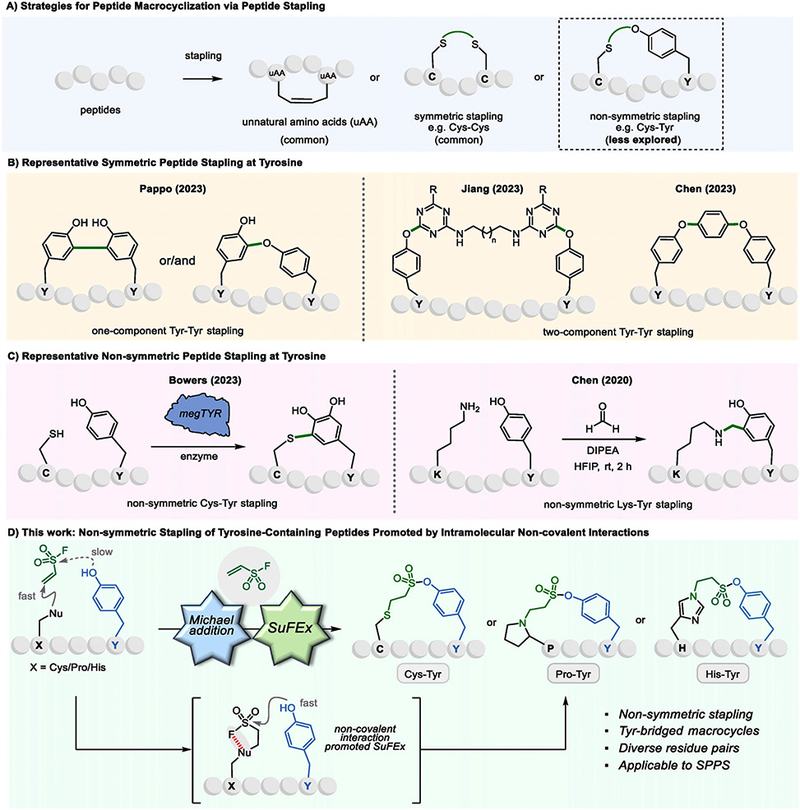
Peptide stapling constrains backbone flexibility to improve target binding and proteolytic stability, yet existing methods predominantly rely on symmetric crosslinking between identical residue pairs, such as Cys–Cys or Lys–Lys, or on nonnatural amino acids, restricting the structural diversity of accessible macrocycles. Nonsymmetric stapling, which bridges two different native residue side chains, holds potential for substantially richer structural variety, but the concept has remained less explored, presumably due to the challenges of achieving chemo- and site-selectivity in complex peptide sequences, and the competitive intermolecular crosslinking that leads to peptide polymerization. Bifunctional SuFEx reagents for nonsymmetric stapling could in principle be designed, but the high reactivity of commonly used aryl sulfonyl fluorides triggers intermolecular crosslinking. Tyrosine compounds this problem: competing nucleophiles such as cysteine, lysine, and histidine tend to intercept any reagent reactive enough to capture the phenolic hydroxyl before the desired intramolecular closure can occur.
Researchers in the Fa-Jie Chen Group at Fuzhou University and collaborators, published in Angewandte Chemie International Edition, reasoned that ethenesulfonyl fluoride, ESF, could resolve this tension through a two-stage reactivity profile. ESF first anchors selectively to a nucleophile such as the cysteine thiol via Michael addition, then holds the sulfonyl fluoride motif in reserve. The key insight is that the resulting β-sulfido sulfonyl fluoride intermediate positions sulfur and fluorine close enough for a chalcogen bond, computed at a S···F distance of 3.10 Å, to activate the sulfonyl fluoride toward an intramolecular SuFEx reaction with a nearby tyrosine, affording the stapled peptide macrocycle. The authors note significant challenges, including competing Michael addition reactions, intolerance to aqueous media, and limited availability of ESF analogues, and state that further optimization is ongoing.
Although less potent than the linear parent, the Cys–Tyr stapled RGD peptide retained nanomolar binding affinity for integrin αVβ3, with the constrained conformation plausibly accounting for the reduced potency by being incompatible with the specific turn conformation required for integrin recognition. Full synthetic scope, mechanistic controls, and biological data are detailed in the original publication.