Phage display and mRNA display have transformed peptide-based drug discovery, but both are constrained by ribosomal synthesis: the building blocks available to encoded libraries consist mostly of the 20 canonical amino acids. Efforts to broaden chemical diversity have added some noncanonical elements, yet the number of non-natural building blocks in libraries remains small. Beyond the fundamental encoding problem, the workflow itself poses a bottleneck: purifying phage particles between modification steps requires PEG precipitation and lengthy centrifugation, limiting throughput and hampering systematic exploration of chemical space. Without a way to chemically diversify large phage libraries in parallel, the promise of combining the selectivity of phage display with the potency of synthetic chemistry remains difficult to realize.
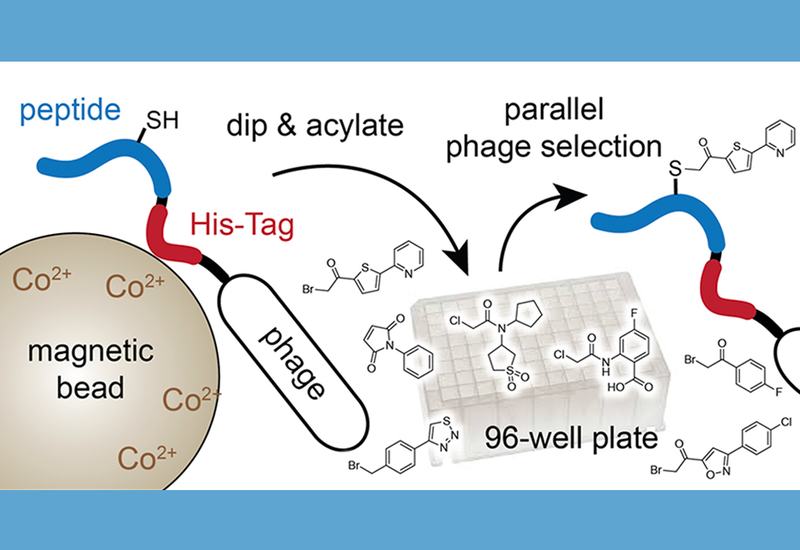
Researchers in the Heinis Group at the École Polytechnique Fédérale de Lausanne, published in the Journal of the American Chemical Society, developed a strategy for parallel chemical diversification of phage display libraries by capturing His-tagged phage on cobalt-nitrilotriacetic acid magnetic beads and moving the bead-bound live phage through different reagents via a 96-well magnetic bead handling device. Each well position spatially encodes its building block, so library composition is defined by experimental layout rather than phage DNA. Applied to the oncology target MCL-1, selections identified binders carrying unnatural building blocks, including thienylpyridine, that were important for binding. The authors attribute enrichment of only one of the 11 building blocks to that structure being uniquely capable of forming a highly favorable molecular interaction with MCL-1, and note that selections against different targets would likely favor entirely different noncanonical building blocks due to distinct molecular recognition requirements.
The strategy increased chemical diversity from 20 canonical amino acids to 31 building blocks, and the authors suggest it may be particularly attractive for generating short peptide-based ligands where proteinogenic amino acid combinations are limited, and for developing lead structures potentially suitable as membrane-permeable ligands, though membrane permeability of the identified peptides has not been demonstrated. The full binding data, sequence analysis, and structure-activity relationships for the MCL-1 binders are reported in the original publication.