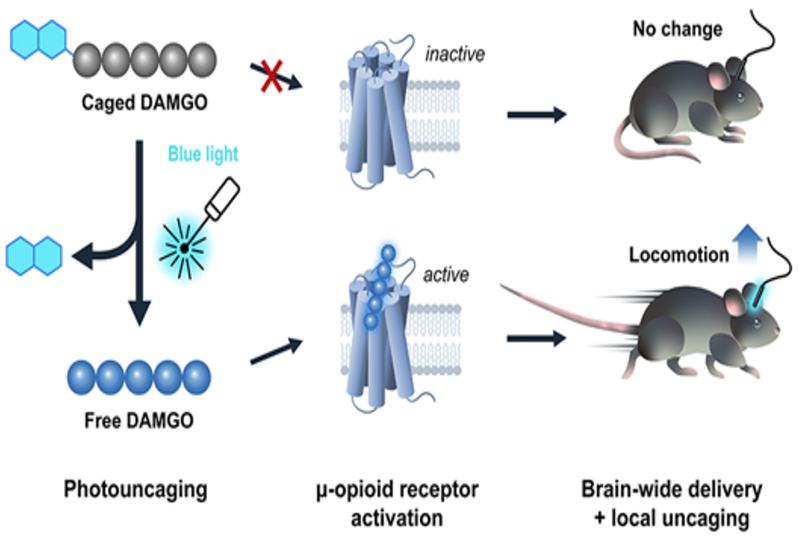
Every caged compound used for one-photon photopharmacology in the nervous system to date has required UV or violet light to uncage, wavelengths that penetrate tissue poorly and raise phototoxicity concerns. Near-infrared two-photon uncaging sidesteps those issues but generates submicron uncaging volumes that do not translate well to behavioral pharmacology experiments. The unmet need is a caged neuropeptide that responds to visible blue light, the same wavelengths delivered by the 473 nm laser lines standard in optogenetics hardware, yet is water-soluble enough for direct brain delivery and inactive enough to serve as a genuine pharmacological control until the moment of illumination.
Researchers in the Banghart Group at the University of California San Diego, published in the Journal of the American Chemical Society, designed TCA-DCCM-DAMGO around a dicyanocoumarin photocage selected for synthetic accessibility and blue-light compatibility. Because a closely related coumarin is incompatible with phenolic leaving groups, the team targeted DAMGO's N-terminal amine via a carbamate linkage. A propargyl handle at the α-position stabilizes the photolabile bond and anchors a tricarboxylate group appended by click chemistry, raising aqueous solubility to near 1 mM. The authors delivered the compound by unilateral intracerebroventricular infusion into the lateral ventricle, which, as they note, "should afford broad distribution in the brain through the circulating cerebrospinal fluid." Despite an uncaging quantum yield of only 0.0021, the DCCM chromophore carries sufficient molar absorptivity at 473 nm that blue-light photouncaging in the mouse ventral tegmental area produced a rapid, opioid-dependent increase in locomotion.
Photoactivation in the mouse ventral tegmental area with blue light produced a rapid, opioid-dependent increase in locomotion blocked by systemic naloxone and absent when either the compound or the light stimulus was omitted, demonstrating feasible in vivo photouncaging deep in the brain. The authors frame TCA-DCCM-DAMGO as a probe for spatiotemporal control of μ-opioid receptor signaling, and identify extending caging-group sensitivity to longer wavelengths while maintaining biodistribution and stability as critical for advancing photopharmacology as both an experimental and translational approach in neuroscience.