Aza-amino acids, in which the α-carbon of a residue is replaced by nitrogen, constrain backbone dihedral angles through nitrogen lone-pair repulsion and urea planarity, locking peptides into defined conformations that can sharpen receptor selectivity and blunt protease attack. Despite this versatility, azapeptide synthesis has remained stubbornly manual. The original submonomer approach builds the aza-amino acid almost entirely on resin from simple commercial reagents, but its key steps call for dichloromethane as solvent, dropwise reagent addition at 0°C, and cooling intervals between heated stages, all incompatible with the liquid-handling and mixing constraints of a standard automated synthesizer. The result is a meaningful bottleneck: aza-scanning of bioactive peptide series is feasible in principle but slow in practice, limiting the breadth of structure-activity studies that laboratories can realistically pursue.
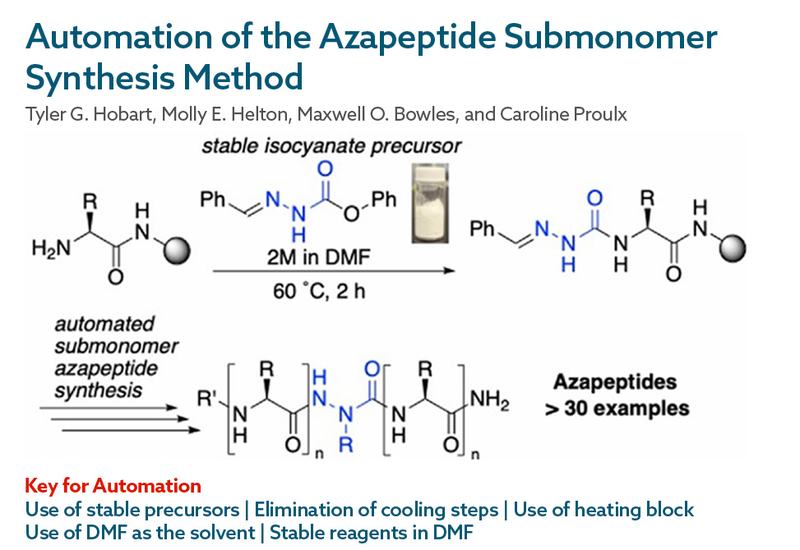
Researchers in the Proulx Group at North Carolina State University, published in the Journal of Peptide Science, report a fully automated submonomer protocol that solves each incompatibility in turn. The central substitution is reagent-level: rather than generating the semicarbazone intermediate by activating benzaldehyde hydrazone in situ at low temperature, the team prepared a bench-stable N-imino-O-phenylcarbamate, reactive with resin-bound amines at 60°C without additives and stable in DMF for at least two weeks as a crystalline solid. The alkylation step required its own fix: dispensing tetraethylammonium hydroxide base directly into the cartridge, followed by the electrophile as a DMF stock solution, restored clean alkylation after other solvent formulations proved unworkable. Semicarbazone deprotection transferred to the synthesizer's heating block at 80°C with no loss of efficiency. With each step adapted, the protocol produced more than 30 azapeptides, including Leu-enkephalin amide derivatives and an aza-GHRP-6 analog, in under a week of instrument time.
A fully automated submonomer route changes the economics of aza-scanning: libraries that previously required weeks of manual effort can now run overnight, putting systematic azapeptide structure-activity exploration within reach for any laboratory equipped for SPPS. The authors note that an expanded aza-tripeptide library is already under investigation for metal-binding applications, with further findings to follow.