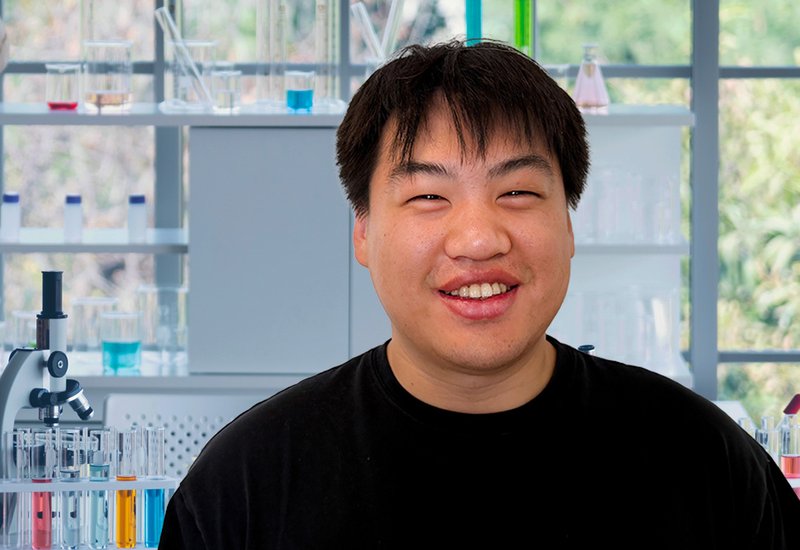
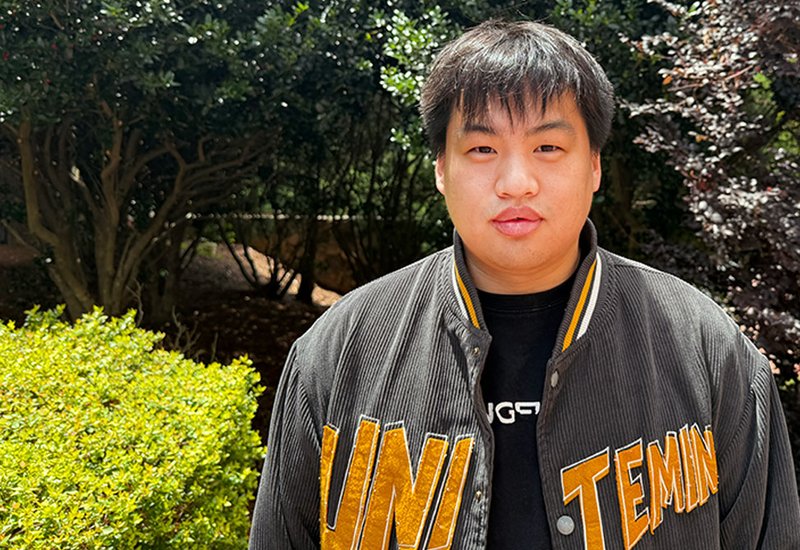
Tiancheng Chen designs constrained peptides to work out how a pair of closely related kinases go wrong. The targets are LRRK1 and LRRK2, homologs that share a structure but split apart in disease. LRRK1 sits behind Osteosclerotic Metaphyseal Dysplasia, a rare bone disorder for which no selective inhibitor has yet been validated. LRRK2 is a leading genetic cause of Parkinson's disease, where the small-molecule inhibitors on hand still carry limitations. Chen's question is whether a peptide can reach what those molecules cannot.
The clearest answer so far runs through a recent paper in Bioorganic Chemistry, covered here on the APS site. Working in the lab of Eileen Kennedy at the Eshelman School of Pharmacy, Chen built hydrocarbon-constrained peptides that mimic the C-terminal helix of LRRK2, a region tied to the protein's kinase activity. The peptides enter cells, bind LRRK2 directly, and shut down kinase function, which suppresses downstream defects in the centrosome and cilia. Many ATP-competitive inhibitors push LRRK2 out of place inside the cell. These peptides leave its localization intact. The finding points to the C-terminal helix as a regulatory handle, and to a different route toward pathogenic LRRK2.
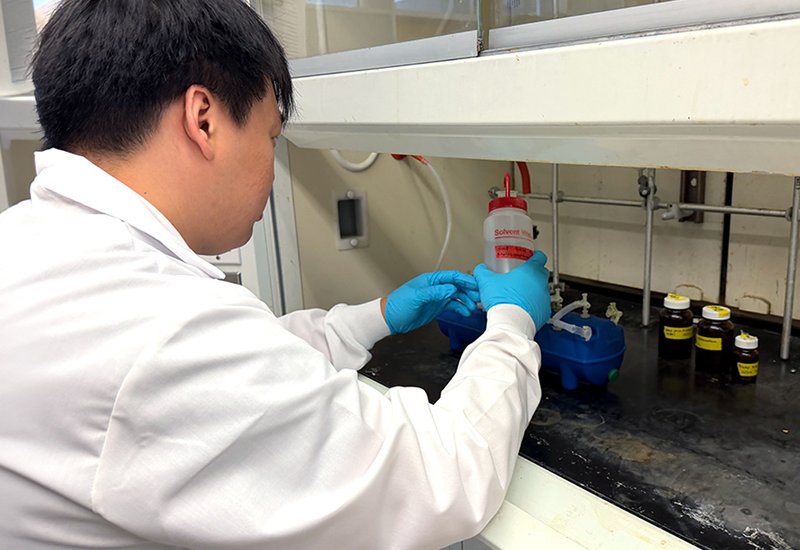
Chen came to peptides through a wider fascination with how small molecular changes ripple into large biological consequences, from evolution to disease. Peptides hold the ground between small molecules and proteins, a middle space with both mechanistic range and therapeutic reach. The rise of GLP-1 therapeutics sharpened the interest. The Kennedy lab was the first real exposure to peptide science, and the chance to design and synthesize constrained peptides against a kinase target was the pull. Solid-phase synthesis and cell-based assays remain the daily tools.
From Kennedy, Chen took a particular idea of what research is for. Work should advance the field, deepen understanding, and help others see a problem from a new angle, rather than chase publications or citations for their own sake. That is the standard Chen hopes to hold to, wherever the path leads.
Chen entered the field at a moment of momentum, with GLP-1 drawing attention from academia and industry alike. At APS 2025 in San Diego, an oral presentation opened into the poster sessions and hallway conversations, among them a thread on the hard problem of moving peptides across the blood-brain barrier to treat neurodegenerative disease. The meeting also widened the lens, with closer looks at cyclic peptides and other engineering strategies.
Looking ahead, Chen is heading toward therapeutic peptide design and drug development, with a clear lean toward industry and translational work. The draw is watching an idea move from concept to a strategy that reaches patients, and the pace at which that can happen.
For undergraduates weighing graduate study, Chen's advice is less about the science than the people. Choose the advisor carefully. Styles, philosophies, and expectations vary widely, and a Ph.D. brings setbacks: failed experiments, the grind of publishing, the qualifying exam. A mentor whose approach fits can keep curiosity alive through all of it.
Outside the lab, Chen recharges with sports, new food spots, video games, and a cat. The cat, above all. After a long day at the bench, a few minutes with her curled alongside, sometimes a face buried in her soft belly, is enough to make the day's stress feel smaller.
Selected publications
Constrained peptide mimics of the LRRK2 C-terminal helix inhibit its kinase activity. Bioorganic Chemistry, 2026.
Targeting Rab-RILPL interactions as a strategy to downregulate pathogenic LRRK2 in Parkinson's disease. Journal of Peptide Science, 2024.
BMP-ACVR1 axis is critical for efficacy of PRC2 inhibitors in B-cell lymphoma. Advanced Science, 2024.
Recognition
Travel Grant, 29th American Peptide Symposium and 15th International Peptide Symposium, American Peptide Society, 2025.
PBS Junior Student of the Year, University of Georgia, 2023.
Gold Prize, International Genetically Engineered Machine Competition, iGEM, 2018.