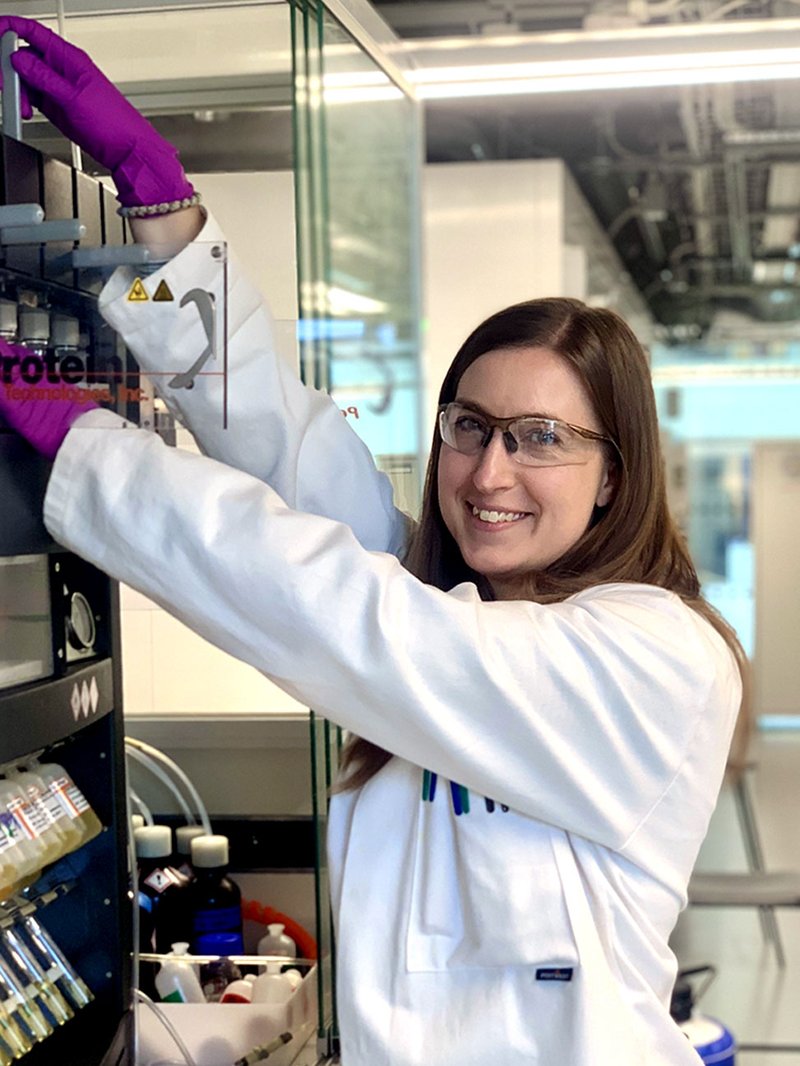
When Cecilie Mia Jørgensen was in high school, she spent a few weeks in a laboratory at Novo Nordisk studying GLP-1. She did not think much of it at the time. Years later, as she completes her Ph.D. at Imperial College London and The Francis Crick Institute, she can trace an almost unbroken line from that afternoon in a Danish lab to her current work developing photoreactive peptide probes for one of cardiovascular medicine's most consequential targets.
That target is PCSK9, a circulating protein that disrupts LDL cholesterol receptor recycling and drives elevated LDL-C levels in plasma. Inhibiting the interaction between PCSK9 and the LDL receptor has already produced approved antibody therapies. Jørgensen's contribution is a new class of chemical tools for studying how PCSK9 behaves once it is inside the cell.
Photo-crosslinking peptides form a covalent bond with a binding partner when activated by UV light, locking the probe to its target and eliminating dissociation. That covalency simplifies downstream experiments considerably, from visualizing protein trafficking to mapping binding sites. But developing a photo-crosslinking peptide that combines high binding affinity with efficient crosslinking has historically required extensive synthetic iteration, often guided by structural information the researcher does not have.
Jørgensen's Ph.D. project addresses that bottleneck directly. Working in the lab of Associate Professor Louise Walport, she developed a single-round mRNA display protocol that converts a hit peptide into a positional scanning library: every position in the peptide sequence carries a different photoreactive amino acid, and a single affinity selection round against PCSK9 produces enrichment data that directly predicts which positions crosslink efficiently. Three chemically distinct photoreactive amino acids were screened in parallel, p-azido-phenylalanine, p-benzoyl-L-phenylalanine, and photo-leucine, substantially increasing the probability of identifying an optimal probe without exhaustive synthesis.
The approach yielded high-affinity photoreactive peptides for PCSK9 from two starting hit sequences identified through RaPID, the random non-standard peptide integrated display platform pioneered by Hiroaki Suga and co-workers. One probe was conjugated to a fluorescent dye and used to track PCSK9 internalisation through early endosomal, late endosomal, and lysosomal stages in HepG2 cells, a complete cellular trafficking picture achieved without the confounding effects of probe dissociation. This work is currently under peer review.
The Novo Nordisk connection in Jørgensen's story runs considerably deeper than the PCSK9 subject matter. After completing a master's degree in Applied Chemistry, she joined Novo Nordisk directly, entering the company's Associate Scientist track before a Ph.D. was on her radar. Colleagues there kept encouraging her toward graduate study, and when she became interested in the RaPID platform, a former colleague pointed her toward the Walport lab. She met Louise Walport at a conference in Copenhagen, and what followed became a formal collaboration: her Ph.D. is co-supervised by Wei Wang and Camille Villequey at Novo Nordisk's Therapeutics Discovery division.
Her industry years also produced lasting scientific contributions. Jørgensen is a co-inventor on several patent applications from her time at Novo Nordisk, including an amylin receptor agonist program now in Phase 1 clinical trials.
Jørgensen attended her first European Peptide Symposium in 2018 knowing no one and found the community unexpectedly welcoming. She has built a sustained network since, and describes the field's openness around both scientific feedback and career questions as genuinely formative for an early-career researcher. At the 2025 Peptide and Protein Science Group Early-Stage Researcher Meeting, she won the RSC Chemical Biology and Organic & Biomolecular Chemistry poster award for her PCSK9 photo-crosslinking work. She also holds the Anglo-Danish Society's Queen Alexandra's Scholarship for Excellence for the 2025-2026 academic year.
At the 2025 Gordon Research Conference on the Chemistry and Biology of Peptides in Ventura, California, she followed a talk by David Thaisrivongs on enzyme-assisted synthesis of Merck's PCSK9 inhibitor MK-0616, a session that landed with particular force given her own work on the same target.
Jørgensen is completing her doctoral thesis and targeting a research position in peptide drug discovery. The industry track she stepped away from to pursue graduate training is precisely where she is headed back, this time with a methodological toolkit she built herself. Outside the lab, she cycles and plays handball. Her team won back-to-back Trophy League titles after she played through a first-year black eye from an elbow. She describes persistence as the key, which is a fair description of her scientific approach as well.