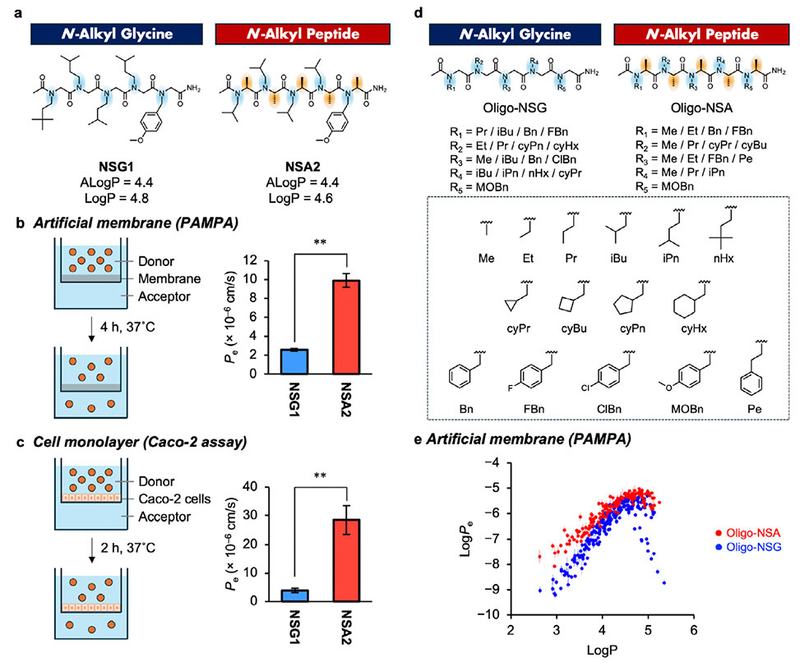
N-alkyl peptides, exemplified by the natural product cyclosporin A, achieve passive membrane permeability that places them among the most promising scaffolds for targeting intracellular proteins. The prevailing explanation centers on N-alkylation removing amide hydrogen-bond donors and thereby lowering the desolvation penalty for crossing a lipid bilayer. That account, however, leaves an awkward gap: peptoids, oligo(N-substituted glycines), carry the same N-alkyl groups and lack the same amide hydrogens, yet they are generally less membrane-permeable than their N-alkyl peptide counterparts at matched lipophilicity. The structural difference between the two classes is the presence or absence of a substituent at the α-carbon, which in conventional N-alkyl peptides generates steric repulsion with the N-alkyl group and rigidifies the backbone dihedral angles φ and ψ. Whether that rigidification contributes independently to permeability, and if so by what mechanism, has remained unresolved.
Researchers in the Morimoto and Sando Groups at The University of Tokyo, published in Angewandte Chemie International Edition, addressed this question by constructing a controlled comparison between oligo(N-substituted glycines) and oligo(N-alkyl alanines), matched for experimentally determined lipophilicity. Because both series lack backbone amide hydrogens, any permeability difference between them can be attributed to backbone steric constraints rather than hydrogen-bond donor count. Parallel artificial membrane permeability assay measurements confirmed that the α-carbon-bearing series consistently outperformed lipophilicity-matched peptoids across a combinatorial library spanning a broad LogP range. To probe whether a specific molecular shape was responsible, the team prepared all 16 stereoisomers of a hexameric sequence: principal moment of inertia analysis showed that these stereoisomers populate widely separated regions of shape space, yet every stereoisomer retained higher permeability, ruling out shape as the primary driver. Molecular dynamics simulations conducted in collaboration with Prof. Yutaka Akiyama and Dr. Masatake Sugita at Institute of Science Tokyo then revealed the mechanistic basisthe dually substituted backbone restricts conformational freedom so that stable peptide–water complexes form less readily, and β-carbons physically shield backbone carbonyl oxygens from water approach, together yielding a lower free-energy cost for traversing the membrane interior.
The findings reframe a design principle the field has long treated as binary: N-alkylation either removes a hydrogen-bond donor or it does not. The work shows that steric geometry around the backbone is an additional, tunable variable. For peptoid-based drug discovery in particular, where the Cα position is unsubstituted by definition, deliberate introduction of α-substituents offers a rational route to improved membrane permeability without simply raising lipophilicity. Full permeability data, simulation details, and synthetic routes are available in the original publication.