Shielding Thioacetals

Reflecting work in the Li Lab

Published here August 20, 2026

Pyridium-π interaction preserves N,S-benzylidene thioacetals in acidolysis enabling efficient protein chemical synthesis

Zhenquan Sun, Yaoyue Zhang, Xueqian Zhao, Yisa Xiao, Zhixiang Zhong, Hongxiang Wu, Xuechen Li

Nature Communications 2026, 17, 7105. https://doi.org/10.1038/s41467-026-73342-3

View Original Publication


Chemical protein synthesis grants atomic-level control over sequence and modification, yet hydrophobic and aggregation-prone proteins remain a stubborn obstacle. N,S-benzylidene thioacetal intermediates, formed at cysteine ligation sites, can disrupt the β-sheet hydrogen bonding that causes aggregation both on resin and in solution. The problem is stability: the p-methoxy-substituted thioacetal undergoes rapid acidolysis under the trifluoroacetic acid, TFA, cocktails required for global side-chain deprotection, vanishing within minutes before it can do its job in later ligation steps. Prior workarounds demanded narrow acidolysis windows and restricted scavenger choice. A more reliable way to protect the thioacetal during deprotection and restore it selectively afterward was the missing piece.

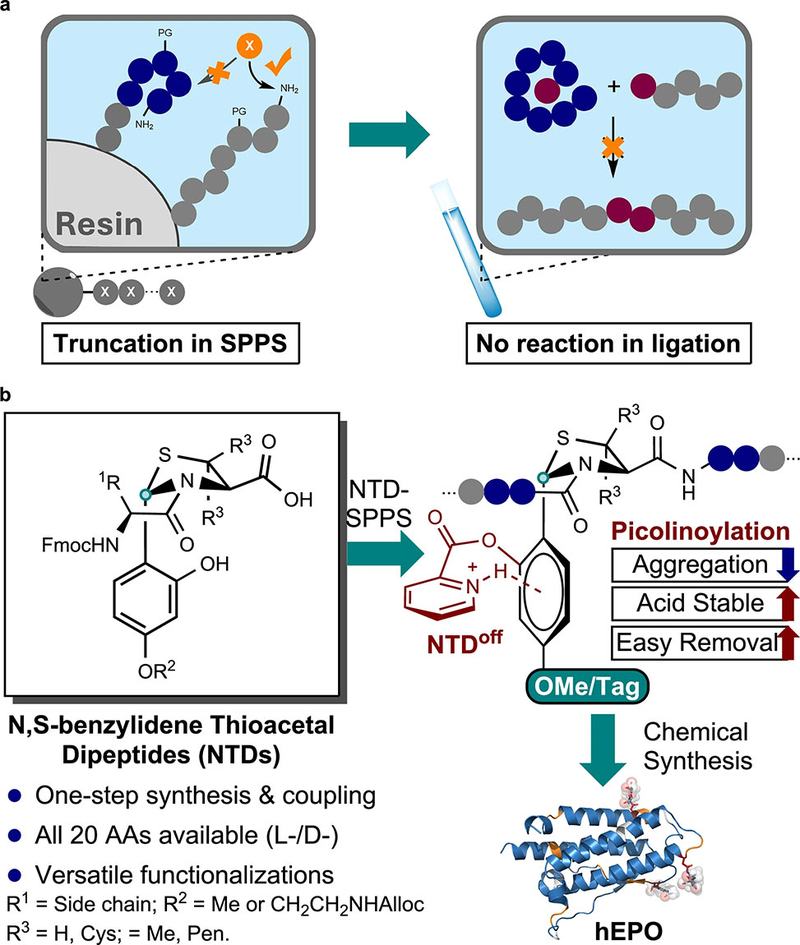
Researchers in the Li Group at The University of Hong Kong, published in Nature Communications, report a solution built around picolinoyl-protected N,S-benzylidene thioacetal dipeptides, NTDs, directly compatible with standard Fmoc SPPS as ordinary coupling partners. Screening a broad set of acylating agents on the thioacetal phenol revealed that 2-picolinoyl chloride stood apart: the NTD remained nearly intact after three hours of TFA/EDT/H₂O treatment, while acetyl and nitrobenzoyl analogs degraded within the same window. DFT calculations and NMR titration studies converged on a mechanistic explanation: under acidic conditions, the pyridine nitrogen is protonated to pyridinium, which forms an offset face-to-face cation-π interaction with the adjacent thioacetal benzene ring at 3.04 Å. This contact depletes electron density at the sulfur atom, creating a charge-repulsion barrier against the first protonation step of acidolysis. The positional specificity is strict, as moving the nitrogen to the meta or para position abolishes both efficient capping and acid stability. The picolinoyl group is subsequently removable under mild pH 4.0–6.0 conditions, providing the on-demand switching the field required.

The NTD strategy enabled convergent total synthesis of human erythropoietin, a 166-residue hydrophobic hormone assembled from five fragments via native chemical and serine/threonine ligations, with NTD sites suppressing aggregation at critical stages. The approach extends to macrocyclization and chemoselective cysteine manipulation in multi-fragment assembly, opening a practical path to difficult proteins that have so far resisted chemical synthesis.
Yaoyue Zhang is a graduate student in Prof. Xuechen Li’s group from the Department of Chemistry at The University of Hong Kong. She earned her B.Sc. from Southern University of Science and Technology. Her research focuses on chemical protein synthesis and the site-specific modification of peptides and proteins, including strategies for aggregation-prone targets.

Dr. Hongxiang Wu is a principal investigator at the Zhongshan Institute for Drug Discovery, Shanghai Institute of Materia Medica, Chinese Academy of Sciences. He completed his Ph.D. from The University of Hong Kong in 2021, studying the chemical synthesis and biological evaluation of glycopeptides and glycoproteins. He subsequently conducted postdoctoral research at HKU, developing several methods including Ligation Embedding Aggregation Disruptor, LEAD, tunable backbone modification, TBM, and N,O-Benzylidene Acetal Dipeptides, NBDs, for enabling the construction of synthetically challenging proteins like PD-1 IgV, and discovering peptide therapeutics through mirror-image phage display. His current research interest focuses on combining chemical synthesis and chemical biology for discovering innovative peptide and protein therapeutic modalities.

Author

Prof. Xuechen Li is Chair Professor and Morningside Professor in Chemical Biology in the Department of Chemistry at The University of Hong Kong. He obtained Ph.D. from Harvard University under the supervision of Professor Dan Kahne, followed by postdoctoral training with Professor Samuel Danishefsky at Memorial Sloan Kettering Cancer Center. Since joining HKU in 2009, his group has developed chemical methods like Ser/Thr Ligation (STL) for de novo peptide and protein synthesis, providing homogeneous proteins bearing precisely defined glycosylation and other post-translational modifications. His research also encompasses the total synthesis and medicinal chemistry of peptides including the translational development of cyclic peptide antibiotics, glycan vaccines, antibody–drug conjugates, and targeted radionuclide therapeutics.

Shielding Thioacetals

a | Illustration of peptide aggregation on resin in SPPS and off resin in chemical ligation. b | Schematic view of NTD strategy in chemical peptide/protein synthesis. PG protecting groups.


Dr. Zhenquan Sun, obtained a BSc Chem from Sun Yat-sen University and completed his Ph.D. in Chemical Biology from The University of Hong Kong under the supervision of Prof. Xuechen Li. As a peptide enthusiast, Zhenquan enjoys solving challenges in the chemical synthesis and site-specific modification of peptides and proteins. He has developed several chemistries such as NaBEt₄-mediated add-and-done, ADD, desulfurization, N,S-benzylidene thioacetal method and aminooxy ligation, AOL, for obtaining therapeutic peptide analogues, precisely modified cytokines and immune checkpoint proteins. He is currently a postdoctoral scholar in Prof. Hening Lin’s group at the University of Chicago, where he investigates how post-translational modification, PTM, enzymes contribute to cancer and autoimmune disease. His current research integrates peptide chemistry, chemical biology, and biomedical modeling to develop cyclic peptides with in vivo bioactivity against pathogenic PTM pathways. Outside the lab, he loves roasting coffee and serves as one of the vice presidents in UChicago BSD Postdoc Association.