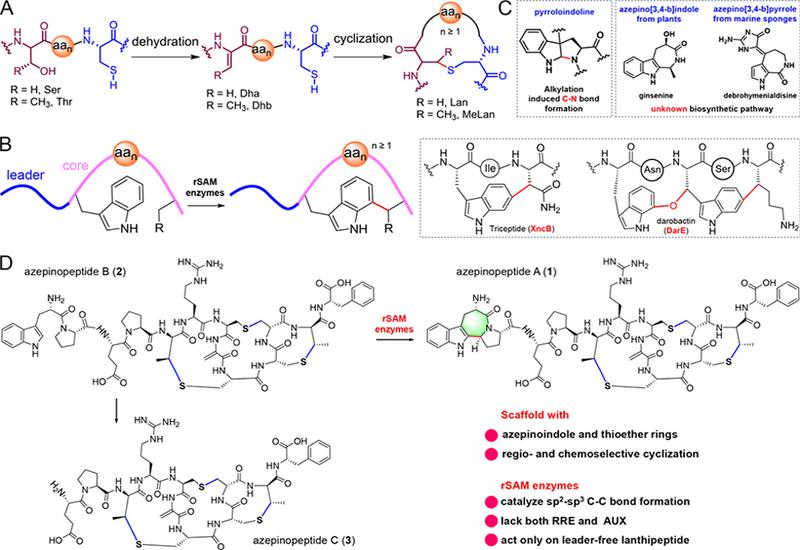
Radical S-adenosylmethionine, rSAM, enzymes are celebrated for installing chemically exotic cross-links in ribosomally synthesized and post-translationally modified peptides, RiPPs, yet one biosynthetic frontier had remained blank: no rSAM enzyme had ever been shown to functionalize a lanthipeptide, and no RiPP rSAM enzyme had ever formed a carbon–carbon bond between two immediately adjacent residues. The azepinoindole scaffold, a seven-membered nitrogen heterocycle fused to an indole, was known only from a handful of plant and marine-sponge alkaloids whose biosynthetic origins remained entirely obscure. Closing either gap would have been notable; the failure to close both left an entire biosynthetic space unexplored and a promising ring architecture inaccessible by any enzymatic route.
Researchers in the Dong Lab at Lanzhou University, published in the Journal of the American Chemical Society, identified the gap by co-occurrence analysis: a sequence similarity network of the Pf04055 rSAM family revealed a cluster of enzymes whose biosynthetic gene clusters encode both an rSAM enzyme and a class IV lanthipeptide synthetase, an unusual pairing that pointed toward undiscovered chemistry. Genome mining recovered 372 such gene clusters, and the most conserved feature of their precursor peptides was a Trp1-Pro2 motif at the N-terminus of the core peptide. Heterologous expression in Streptomyces hosts produced azepinopeptide A, a lanthipeptide bearing three interlocked thioether rings and an unprecedented tetrahydropyrrolo[1′,2′:1,2]azepino[3,4-b]indole moiety. Isotope labeling, NMR analysis, and Marfey's analysis converged on a single structural conclusion: the rSAM enzyme AzeE forges an sp2–sp3 C–C bond between the indole-C2 of Trp1 and the Cδ of Pro2. Crucially, in vitro reconstitution showed that AzeE acts exclusively on the mature, leader-free lanthipeptide substrate, after thioether ring formation and leader removal. This strict ordering explains why these enzymes lack both the RiPP recognition element and the auxiliary iron–sulfur cluster found in other RiPP rSAM systems: the binding pocket, shaped to accommodate the folded, leader-free lanthipeptide, provides the substrate selectivity that other systems delegate to accessory domains.
Azepinopeptides A and B restore neuronal cell viability in an oxygen–glucose deprivation/reperfusion model, while a truncated analogue lacking the Trp1-Pro2 unit shows no significant effect. Bioinformatic follow-up identified 327 additional azepinopeptide-like gene clusters, indicating that this lanthipeptide rSAM subclass is broadly distributed in bacteria. The full structural data, mechanistic labeling experiments, and mutational analysis are reported in the original publication.