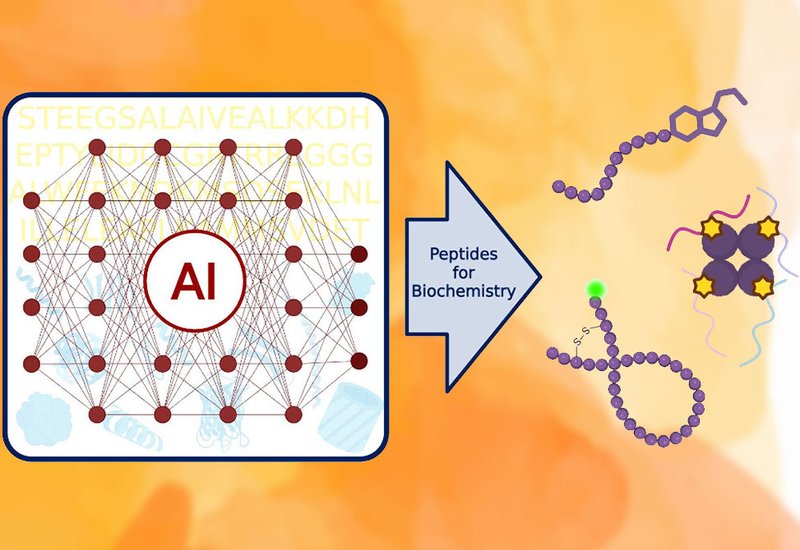
Antibodies remain the dominant affinity reagents in biochemical research, underpinning Western blotting, immunoprecipitation, and flow cytometry. Yet their limitations are well documented: variable performance across experimental contexts, reproducibility failures, and limited transparency about binding determinants, particularly for reagents derived through animal immunization. Recombinant alternatives such as nanobodies and designed miniproteins partially address these issues but still depend on folded protein scaffolds and nontrivial optimization pipelines. Peptides occupy a distinctive intermediate niche: larger and more conformationally flexible than small molecules, yet far smaller and more synthetically tractable than full-length proteins. They can engage extended protein surfaces, recognize short linear motifs and intrinsically disordered regions, and be conjugated to reporters or degradation machinery without immunogenicity concerns. Conventional discovery workflows, relying on phage display, combinatorial library screening, or iterative mutagenesis, have historically constrained their broader adoption as general-purpose reagents.
Researchers in the Chatterjee Group at the University of Pennsylvania, published in Biochemistry as part of a special issue on the chemistry and biology of peptides, survey the emerging landscape of AI-designed peptides as practical biochemical tools. The review organizes the field around two dominant design paradigms: sequence-based and structure-based. Structure-based methods, including RFdiffusion, RFpeptides, BindCraft, and BoltzGen, condition peptide generation on three-dimensional receptor coordinates and binding-site hotspots, excelling when high-quality structural information is available. Sequence-based methods, including PepMLM, PepPrCLIP, moPPIt, and SOAPIA, operate directly in sequence space and access a broader range of targets, interaction modes, and chemical modifications, including intrinsically disordered regions and cases where structural data are sparse. The authors provide a decision tree to guide experimentalists in selecting between the two paradigms for a given biochemical task.
A central argument of the review is that AI-designed peptides can now be optimized simultaneously across multiple objectives, a capability that conventional discovery workflows cannot easily replicate. Multi-objective frameworks such as PepTune, moPPIt, and TR2-D2 couple discrete diffusion or flow-matching generators to pretrained property predictors, steering sequence generation toward candidates that jointly satisfy binding affinity, solubility, membrane permeability, hemolysis, and nonfouling constraints. Sequence-based models such as SOAPIA incorporate off-target protein sequences explicitly during training to reduce cross-reactivity without requiring structural data, enabling isoform- and paralog-level discrimination. The review also highlights chemical language models operating in SMILES, HELM, and CHUCKLES notation, which support noncanonical amino acids, chemical modifications, and macrocyclic topologies, expanding the design space well beyond the 20 canonical residues.
Beyond affinity reagents, the review describes peptides as modular components for programmable proteome editing. Genetically encoded peptide-guided E3 ubiquitin ligases, termed uAbs, use "guide" peptides fused to E3 ligase catalytic domains to direct ubiquitination and degradation of selected proteins, while peptide-directed deubiquitinases, termed duAbs, recruit OTUB1 deubiquitinase activity to stabilize protein targets. The authors draw an analogy to CRISPR, noting that both systems separate targeting from enzymatic action to enable programmable, sequence-defined intervention without altering the underlying genome. Related strategies, including PepTACs, DUBTACs, and DEPTACs, extend this recruitment framework to additional enzymatic activities, with the authors anticipating that improving peptide affinity, specificity, and intracellular compatibility will broaden access to these tools.
The review frames AI-designed peptides not as a replacement for antibodies but as a design-driven complement that shifts discovery from trial-and-error iteration toward assay-ready reagent generation. The authors anticipate that integration of AI design with automated synthesis, high-throughput screening, and closed-loop experimental feedback will allow peptide reagents to be generated, tested, and refined on demand. In this regime, peptides move beyond simple affinity tools and become programmable molecular reagents that link sequence design directly to biochemical function and cellular behavior, including induced degradation, stabilization, and pathway modulation.