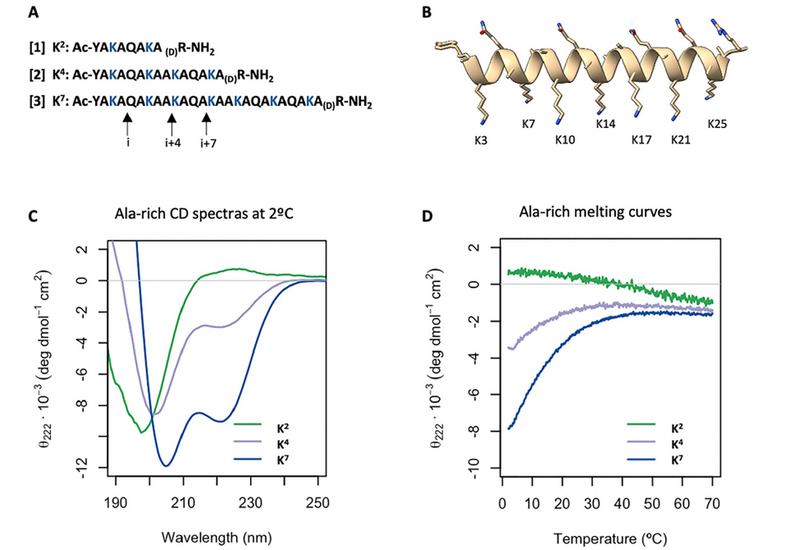
Short peptides are notoriously poor at maintaining α-helical structure in solution at physiological temperatures: the same flexibility that allows folding also allows unfolding. Prior work showed that adsorption onto gold, silica, or hydroxyapatite nanoparticles can coax peptides into helical conformations, but those interactions are ionic, and the resulting structures tend to be sensitive to changes in temperature, pH, and salt concentration. For applications where a peptide must present a defined structural face to a partner protein, that fragility is a genuine obstacle: the helix must stay helical even under stress, and the binding face must remain solvent-exposed and accessible.
Researchers in the Wendeborn and Shahgaldian Group at the University of Applied Sciences and Arts Northwestern Switzerland, published in Angewandte Chemie International Edition, addressed this by turning the chemistry of surface immobilization itself into a conformational selection tool. Their approach begins with alanine-rich peptides carrying lysine residues positioned to fall on a single face of a prospective α-helix. At alkaline pH and low temperature, the peptide pre-folds in solution, aligning those lysine side chains. The peptides then encounter glutaraldehyde-activated, amine-functionalized silica nanoparticles, SNPs, under conditions where reversible imine bonds can form and exchange, sampling surface-attachment geometries until the helical conformation is thermodynamically favored. Reductive amination with NaBH4 then converts those dynamic imines into stable secondary amines, locking the peptide covalently to the SNP surface in its helical pose. A systematic study of lysine spacing reveals a key design trade-off: placing one lysine per helical turn maximizes thermal stability, while spacing attachments every two turns yields a more geometrically ideal helix at lower temperatures but with reduced stability at high temperatures. Critically, the face of the helix oriented away from the nanoparticle surface remains accessible, as confirmed by streptavidin-binding experiments in which immobilized peptides capture their protein partner and retain that capacity, to a measurable degree, even after incubation at 70°C.
The result is a sequence-guided framework for building thermally robust peptide helices on nanoparticle surfaces without sacrificing the functional interface. The approach is compatible with different dialdehyde linkers and, in principle, extensible to any bioactive helix whose attachment residues can be positioned on one face. The full binding data, structural characterization, and design rules for lysine patterning are detailed in the original publication.