Hemorrhage accounts for roughly 40% of trauma-related fatalities and more than a quarter of maternal deaths worldwide, and the problem is especially acute in patients with thrombocytopenia, where reduced platelet counts leave the clotting system critically weakened. Current treatments rely heavily on plasma-derived products that are expensive, require specialized storage, carry risks of viral transmission, and depend on human donors. Nanoparticle-based hemostatic agents have shown promise but face persistent hurdles with immune clearance, manufacturing complexity, and regulatory approval. What the field needs is a programmable, pathogen-free platform that reinforces blood clots at wound sites without promoting dangerous clotting elsewhere in the body.
Researchers supervised by Professor Michael A. Nash at the University of Basel, published in the Journal of the American Chemical Society, engineered a library of 12 recombinant elastin-like polypeptides bearing glutamine-rich peptide motifs they call Q-blocks. These Q-block-ELPs exploit the natural coagulation cascade: when bleeding triggers the activation of coagulation factor XIIIa, the transglutaminase recognizes the Q-block sequences and covalently cross-links the polypeptides into the nascent fibrin network. The team tuned the constructs to phase-separate at body temperature by varying three molecular parameters, central block length, Q-block valency, and guest residue hydrophobicity, creating protein-rich coacervates that concentrate at wound sites and serve as additional cross-linking hubs within the clot architecture.
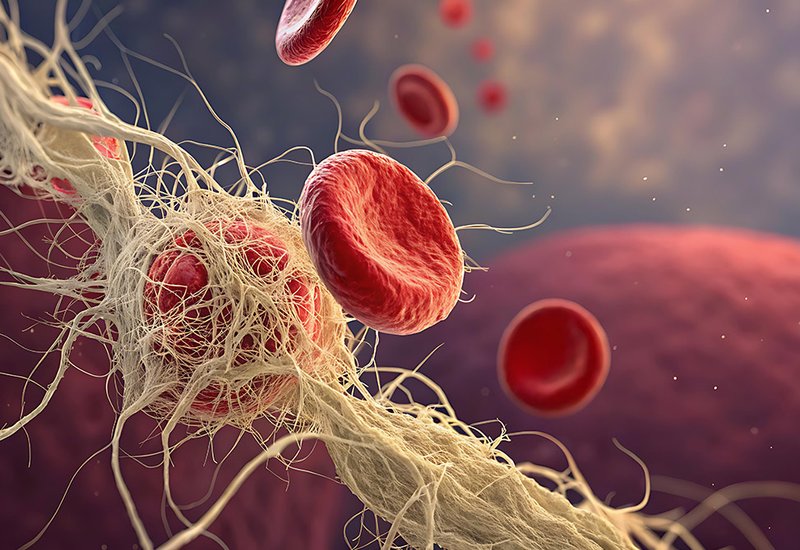
Rheology measurements showed that lead constructs ELP1 and ELP2 significantly increased fibrin gel stiffness compared to buffer controls. Scanning electron microscopy revealed that Q-block-ELP-treated clots formed denser networks of thinner, more highly interconnected fibers, while a control ELP lacking the critical glutamine residues produced clots indistinguishable from untreated fibrin. Confocal fluorescence microscopy confirmed that the polypeptides colocalized with fibrin fibers, and SDS-PAGE demonstrated covalent incorporation into the network. In thrombocytopenic mice depleted to approximately 43% of baseline platelet counts, intraperitoneal administration of ELP2 at 150 mg/kg reduced blood loss by up to 60%, accelerated clot initiation two- to threefold, and boosted maximum clot amplitude up to tenfold as measured by thromboelastography. The team observed a dose-dependent trend across both male and female mice, with a subset of animals receiving the higher dose achieving complete cessation of bleeding within 30 minutes, an outcome not seen in any control animal. By comparison, tranexamic acid, a widely used clinical antifibrinolytic, failed to reduce blood loss in the same thrombocytopenic model, likely because it inhibits clot breakdown rather than promoting clot formation under platelet-deficient conditions. Importantly, Q-block-ELPs did not accelerate clotting or increase clot stiffness in human blood with normal platelet counts, and no elevation of circulating IgM or IgG was detected seven days after administration, providing early evidence against off-target thrombosis and acute immunogenicity.
By coupling enzyme-responsive design with temperature-driven self-assembly, Q-block-ELPs achieve clot-specific integration that is spatially and temporally controlled by the coagulation cascade itself. This modular framework, built entirely from genetically encoded and recombinantly produced protein polymers, offers a scalable, pathogen-free alternative to plasma-derived hemostatic products for patients with impaired platelet function.