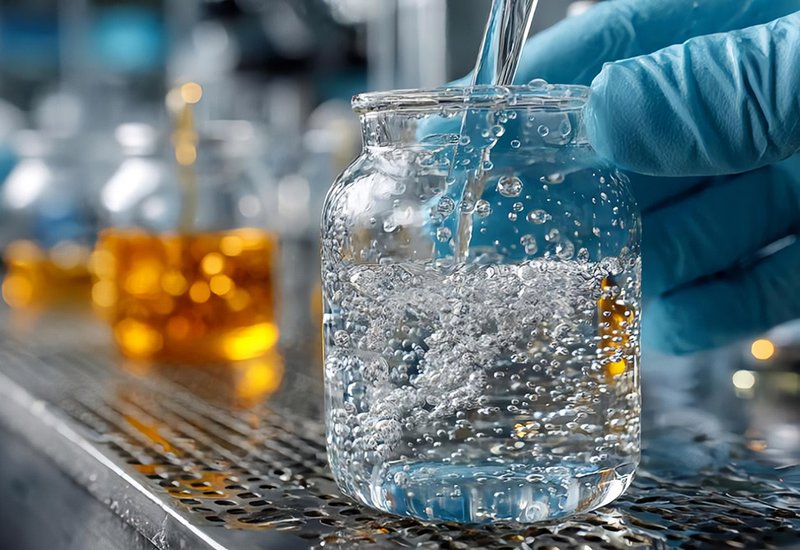
Solid-phase peptide synthesis remains the dominant technology for producing peptides at every scale, from milligrams in academic labs to metric tons in pharmaceutical manufacturing. The method relies on the widely adopted Nα-Fmoc protecting group strategy, which is efficient, mild, and truly orthogonal. Yet this workhorse chemistry carries a serious environmental burden. The solvents that make SPPS possible, principally N,N-dimethylformamide and N-methylpyrrolidone, are classified as substances of very high concern under European REACH regulations due to their carcinogenic, mutagenic, or reproductive toxicity. Producing one kilogram of a GLP-1 receptor agonist peptide can require 14 metric tons of organic solvent. With the peptide therapeutics market projected to reach 75 billion dollars by 2028, the pressure to find sustainable alternatives has never been greater.
Researchers supervised by Professor Donald A. Wellings at SpheriTech Ltd, Nobel Laureate Professor Morten Meldal at the University of Copenhagen, and Professor John D. Wade at the University of Melbourne, published in Nature Sustainability, discovered that Nα-Fmoc-amino acids can be made readily soluble in water through a remarkably simple approach: forming amine salts with N-methylmorpholine or N,N,N-triethanolamine. All 20 conventional Fmoc-amino acids, including those bearing side-chain protecting groups, dissolved at concentrations of 0.4 to greater than 1.0 M. The team confirmed the salt structures by 3D electron diffraction crystallography and 1H-NMR spectroscopy, then adapted the solubilization method to a full aqueous Fmoc-SPPS protocol using a water-soluble carbodiimide activation system and a novel biodegradable solid support, SpheriTide Aq, made from cross-linked poly-ε-lysine.
The aqueous protocol delivered high-quality peptides across three test sequences of increasing complexity. Leu-enkephalin, a standard benchmarking pentapeptide, reached 90.4% crude purity. The notoriously aggregation-prone decapeptide ACP(65-74) assembled without difficulty using 50% aqueous urea as a chaotropic co-solvent, achieving greater than 85% purity. Bivalirudin, a clinically used 20-residue thrombin inhibitor, reached approximately 83% crude purity with excellent intermediate quality throughout the assembly. Critically, the method induced less than 0.50% amino acid racemization and generated only 0.78% aspartimide under stress conditions, compared to 15.04% with conventional piperidine in DMF. For Fmoc deprotection, neat morpholine with ferric chloride as a Lewis acid catalyst achieved complete removal within 60 minutes while sequestering the hydrophobic dibenzofulvene byproduct. The overall process reduced organic solvent use by 94% compared to traditional DMF-based assembly.
These findings establish a practical foundation for water-based chemical production of peptides using existing, commercially available Fmoc-amino acid building blocks. By eliminating the need for hazardous organic solvents in the core synthesis cycle, this methodology addresses the most urgent sustainability challenge facing the peptide manufacturing industry. Further refinements now underway, including heated reaction protocols and continuous flow adaptation, point toward fully green peptide production at industrial scale.