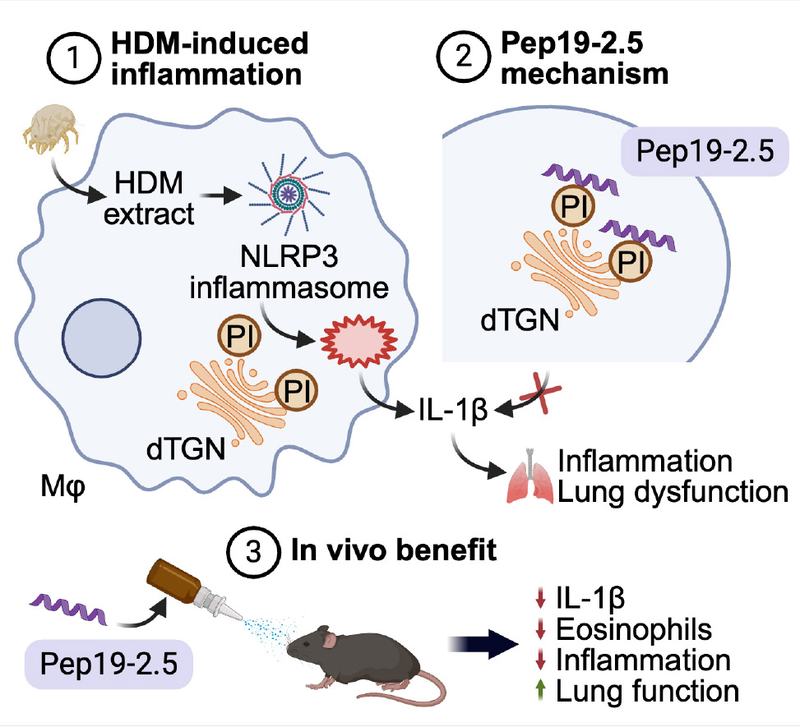
The NLRP3 inflammasome is one of the innate immune system's most consequential triggers: once activated, it drives caspase-1, IL-1β secretion, and pyroptotic cell death, fueling conditions from allergic asthma to gout. Most investigational NLRP3 inhibitors, including the widely studied MCC950, bind the NLRP3 NACHT domain directly and suppress its ATPase-driven conformational switch. That mechanism works, but a critical and underexploited step in inflammasome assembly is the recruitment of cytosolic NLRP3 to the dispersed trans-Golgi network, dTGN, where the phosphoinositide PI4P anchors the protein for palmitoylation, oligomerization, and eventual ASC nucleation. Disrupting this lipid-docking event blocks the cascade before ASC ever forms a speck, yet no clinical-stage agent exploits it. Membrane-active antimicrobial peptides interact with host-cell lipid bilayers as part of their immunomodulatory activity, raising the question of whether a peptide with known PI-lipid affinity could interfere with NLRP3's membrane-recruitment step.
Researchers in the Weindl Group at the University of Bonn and the Schromm Group at the Research Center Borstel, Leibniz Lung Center, published in Advanced Science, report that the synthetic LPS-neutralizing peptide Pep19-2.5 selectively suppresses NLRP3 inflammasome activation through a membrane-targeting mechanism distinct from classical small-molecule inhibitors. The peptide inhibits IL-1β secretion triggered by canonical NLRP3 activators yet leaves NLRP1- and AIM2-driven responses untouched, establishing pathway specificity. Biophysical dissection ruled out direct binding to the NACHT domain, and the mechanistic pivot came from electrophoretic light scattering and membrane-coated bead experiments showing that Pep19-2.5 binds preferentially to PI4P-containing membranes, neutralizes their surface charge, and accumulates in PI4P-enriched perinuclear compartments that co-localize with the dTGN marker TGN38 in human macrophages. A sequence comparison revealed structural similarity between Pep19-2.5 and the NLRP3 polybasic region responsible for PI4P docking, suggesting the peptide competes for the same lipid surface and thereby suppresses ASC oligomerization at an early, membrane-proximal node in the assembly pathway.
The translational implications come into focus in a house dust mite model of allergic airway inflammation, where nasal aerosol delivery of Pep19-2.5 attenuated bronchoalveolar IL-1β, eosinophil infiltration, and impaired lung function without observable adverse effects. For peptide scientists, this work charts a new design space: polycationic, membrane-active scaffolds that redirect to intracellular PI4P compartments can intercept inflammasome signaling upstream of the protein-assembly steps that conventional inhibitors target. The full mechanistic data, structural comparisons, and in vivo results are available in the original publication.