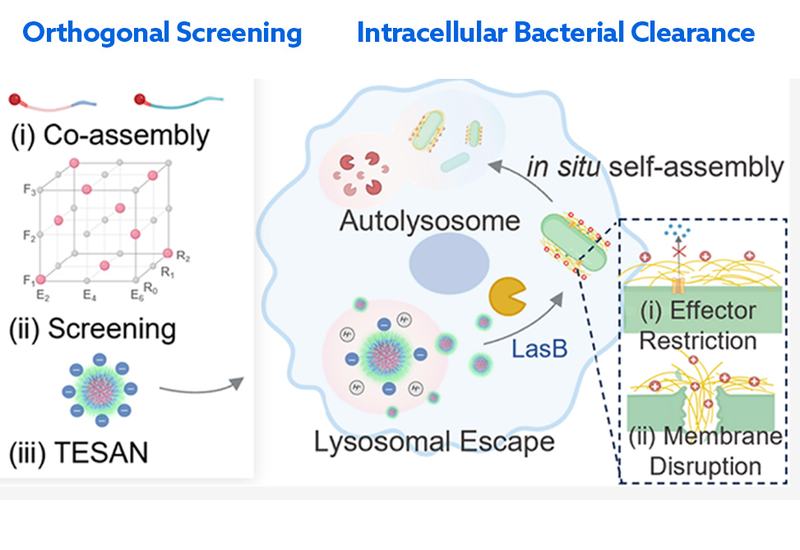
Bacteria that colonize the interior of macrophages pose a treatment problem that conventional antibiotics cannot fully solve. Pseudomonas aeruginosa and related intracellular persisters are shielded by the host cell membrane from circulating drugs, but they do not simply hide: they actively secrete effector proteins, such as ExoS, that block the fusion of autophagosomes with lysosomes, converting the macrophage from predator to sanctuary. Strategies that target only bacterial killing leave this immunosuppressive microenvironment intact, so when treatment stops, dormant bacteria reactivate and the infection rebounds. What is needed is a system that can reach the intracellular bacterial niche, kill persisters there, and simultaneously neutralize the virulence machinery that disables host immunity — all without harming the host cell.
Researchers in the Zhan Lab at Nanfang Hospital, Southern Medical University, published in J. Am. Chem. Soc., engineered a two-peptide coassembly called TESAN, a targeted and enzyme-activated self-assembling nanofiber system. A D-mannose head group steers TESAN into macrophages via mannose receptors. Glutamic acid repeats mask the cationic charge during transit, suppressing host toxicity; acidification in the lysosomal compartment protonates these residues and facilitates lysosomal escape. Once the peptides reach the cytosol and contact intracellular P. aeruginosa, the bacterium's own elastase B, LasB, cleaves an AGLA linker. That cleavage event simultaneously unmasks arginine-rich cationic sequences that disrupt bacterial membranes and lowers the critical micelle concentration from roughly 28 μM to roughly 8 μM, driving a morphological transition from nanoparticles to dense β-sheet nanofibers directly on the bacterial surface. The assembled fiber network acts as a physical cage: it restricts the diffusion of effector proteins outward, reducing ExoS expression and restoring autophagosome-lysosome fusion to levels well above untreated infected controls.
In a murine pulmonary infection model, TESAN achieved a 4.64 log10 reduction in bacterial burden and raised seven-day survival from 10% to 70%. The system also translated to clinical material: alveolar macrophages isolated from patient bronchoalveolar lavage fluid showed up to 99.91% intracellular bacterial elimination. The modular architecture, combining a targeting motif, charge-masking domain, enzyme-responsive linker, and self-assembling scaffold, is in principle programmable for other intracellular pathogens, making TESAN a design template worth examining in the full paper.