Editing Serine's Silence

Reflecting work in the Li Lab

Published here August 20, 2026

Site-Specific and Programmable Editing of Serine and Threonine in Unprotected Peptides

Zhenquan Sun, Percy Man-Kit Liao, Adrian Kin Nam Chu, Alvin Wai Leung Lam, Yaoyue Zhang, Jie Yu, and Xuechen Li

J. Am. Chem. Soc. 2026, 148, 30418–30428. https://doi.org/10.1021/jacs.6c09445

View Original Publication


Serine and threonine sit at the heart of cellular regulation, serving as the primary attachment points for phosphorylation and O-glycosylation across the proteome. Yet while chemists have turned cysteine, lysine, and tyrosine modification into routine operations, analogous control over serine and threonine in unprotected polypeptides has remained largely inaccessible. Two intrinsic obstacles conspire against progress: the hydroxyl side chains of both residues are weak nucleophiles under aqueous conditions, and multiple indistinguishable sites within a single protein offer no obvious handle for selectivity. Forcing reactivity through highly electrophilic reagents sacrifices selectivity, while bottom-up chemical protein synthesis requires sophisticated, often fragile, pre-installed building blocks for each modification type. Neither path offers a general, programmable solution.

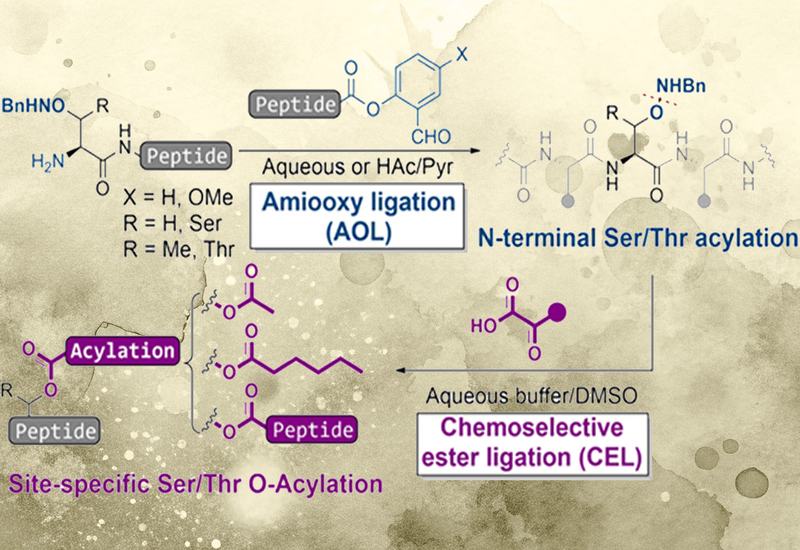
Researchers in the Li Group at The University of Hong Kong, published in the Journal of the American Chemical Society, report a two-stage surrogate strategy that sidesteps the nucleophilicity problem entirely. Rather than coaxing the native hydroxyl into reacting, the team replaces it temporarily with aminooxy serine or aminooxy threonine, residues whose stronger aminooxy nucleophilicity drives a chemoselective N-terminal ligation, termed aminooxy ligation, AOL. The key mechanistic finding is that AOL proceeds via a transient six-membered 1,2,4-oxadiazinane intermediate, confirmed by NMR isolation of a capped dipeptide model: this ring closure positions the acyl group for a proximity-induced, irreversible 1,5-acyl transfer, releasing a salicylaldehyde and delivering the ligated peptide cleanly in aqueous buffer. The aminooxy group remaining after ligation then serves as the entry point for a second transformation, chemoselective ester ligation, CEL, in which reaction with a keto acid proceeds through an oxaziridine-mediated rearrangement to deliver direct O-acylation at the target residue. Isotope-labeling experiments with H218O traced the oxygen origin in the ester carbonyl, supporting the proposed mechanism and distinguishing the productive pathway from competing amide-forming side routes.

Together, AOL and CEL constitute a modular editing platform that converts a single surrogate residue into a native O-glycosylated, O-acylated, or restored Ser/Thr residue under mild aqueous conditions, without protecting-group manipulation of other sites. The authors demonstrate the approach across therapeutic peptide analogues and extend it to convergent synthesis of full-length histone H2B carrying site-specific modifications. The full scope of substrates, mechanistic controls, and biological applications awaits in the original publication.
Percy Man-Kit Liao is currently a final year Ph.D. student at the University of Hong Kong under the supervision of Professor Xuechen Li. He earned his B.S degree at the The Hong Kong University of Science and Technology in 2022 in chemistry and biology and completed his final year project under the supervision of Professor Jianwei Sun. His research interests center on two major fields, 1| developing novel γPNA synthesis, structure design for programmable site-specific artificial nuclease, molecular circuit and nanostructure construction; 2| developing new chemistry for chemical synthesis and late-stage installation of PTM of proteins.

Adrian Kin Nam Chu is a graduate student in Professor Xuechen Li’s group at The University of Hong Kong. He earned his B.Sc. from HKU as well. His research interests include peptide ligation, peptide modification, and peptide drug screening.

Alvin Wai Leung Lam obtained his B.Sc. in Chemistry from The University of Hong Kong. He currently pursuing his Ph.D. in Professor Xuechen Li’s group at HKU. His research focuses on chemical synthesis of difficult proteins including PD-1 IgV domain and the precise installation of modifications in unprotected biomolecules.

Author

Prof. Xuechen Li is Chair Professor and Morningside Professor in Chemical Biology in the Department of Chemistry at The University of Hong Kong. He obtained Ph.D. from Harvard University under the supervision of Professor Dan Kahne, followed by postdoctoral training with Professor Samuel Danishefsky at Memorial Sloan Kettering Cancer Center. Since joining HKU in 2009, his group has developed chemical methods like Ser/Thr Ligation (STL) for de novo peptide and protein synthesis, providing homogeneous proteins bearing precisely defined glycosylation and other post-translational modifications. His research also encompasses the total synthesis and medicinal chemistry of peptides including the translational development of cyclic peptide antibiotics, glycan vaccines, antibody–drug conjugates, and targeted radionuclide therapeutics.

Editing Serine's Silence

Dr. Zhenquan Sun, obtained a BSc Chem from Sun Yat-sen University and completed his Ph.D. in Chemical Biology from The University of Hong Kong under the supervision of Prof. Xuechen Li. As a peptide enthusiast, Zhenquan enjoys solving challenges in the chemical synthesis and site-specific modification of peptides and proteins. He has developed several chemistries such as NaBEt₄-mediated add-and-done, ADD, desulfurization, N,S-benzylidene thioacetal method and aminooxy ligation, AOL, for obtaining therapeutic peptide analogues, precisely modified cytokines and immune checkpoint proteins. He is currently a postdoctoral scholar in Prof. Hening Lin’s group at the University of Chicago, where he investigates how post-translational modification, PTM, enzymes contribute to cancer and autoimmune disease. His current research integrates peptide chemistry, chemical biology, and biomedical modeling to develop cyclic peptides with in vivo bioactivity against pathogenic PTM pathways. Outside the lab, he loves roasting coffee and serves as one of the vice presidents in UChicago BSD Postdoc Association.