Antibiotic discovery has long depended on positive-selection screens against predefined protein targets, a logic that narrows the search space and leaves genuinely novel vulnerabilities unexplored. Cyclic peptides are well suited to intracellular targets, and genetically encoded libraries produced by split-intein circular ligation of peptides and proteins, SICLOPPS, can generate millions of members expressed one-per-cell inside living bacteria. Yet connecting a phenotypic antibacterial hit to its intracellular target has remained a persistent bottleneck, and distinguishing genuine dropout sequences from sequencing noise across a library of millions is a combinatorial problem that existing motif-search tools were not built to solve.
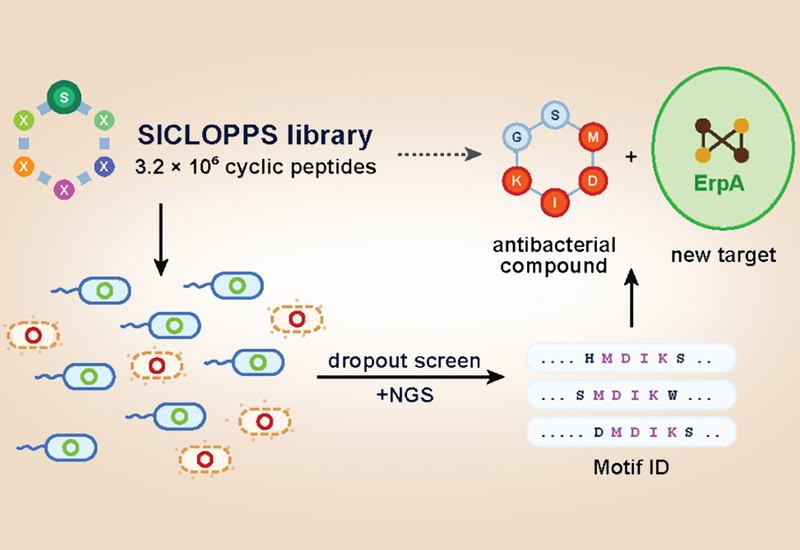
Researchers in the Tavassoli Group at the University of Southampton, in collaboration with researchers at Merck & Co. Inc., published in J. Am. Chem. Soc., reasoned that flipping the selection logic could address both problems at once. Their dropout screen pairs a SICLOPPS library of 3.2 million cyclic hexapeptides with next-generation sequencing of the surviving bacterial population: sequences whose encoded cyclic peptides harm the host are depleted, and their absence is the signal. To separate genuine dropouts from sampling noise, the team developed a matrix-based pharmacophore clustering framework that counts the abundance of every possible di-, tri-, and tetrapeptide motif before and after induction and ranks motifs by fractional depletion. Tetrapeptide resolution proved critical: the MDIK motif emerged as the top-ranked hit, and a gradient of dropout signal across the flanking residues of cyclo-SMDIKG independently validated MDIK as the active pharmacophore. Target identification combined a biotinylated pull-down probe with genetic rescue experiments, and only ErpA, an A-type iron–sulfur cluster carrier essential for both aerobic and anaerobic respiration in E. coli, conferred rescue; microscale thermophoresis confirmed direct binding with a KD of 4.3 ± 1.0 μM.
ErpA had not previously been targeted by any reported inhibitor, illustrating how a target-agnostic dropout strategy can surface vulnerabilities that hypothesis-driven campaigns miss. The pharmacophore-clustering framework applies equally to enrichment-based screens, and the authors identify improved potency and outer-membrane permeability as the next engineering challenges for the cyclo-SMDIKX scaffold.