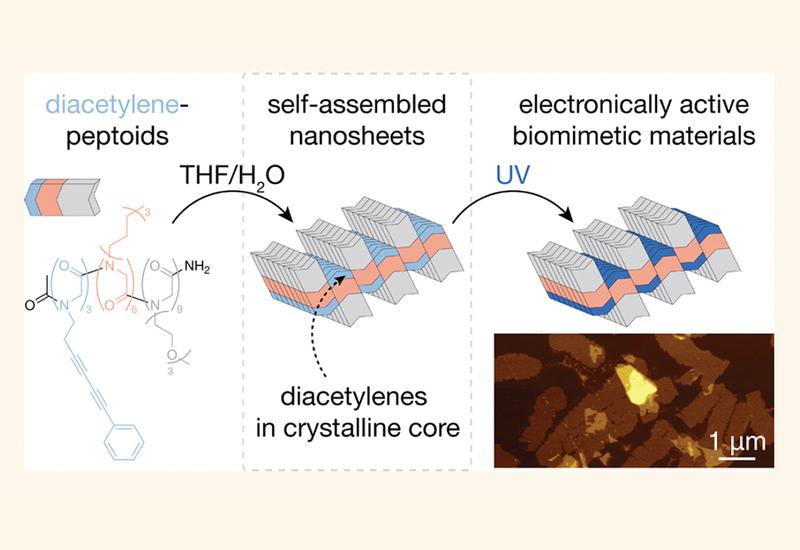
Two-dimensional nanosheets built from peptoids, peptidomimetics with N-substituted glycine backbones, offer a compelling platform for biosensing: their surfaces accept functional groups at programmable densities, and their resistance to enzymatic degradation gives them an edge over peptide- or DNA-based alternatives. Yet every existing peptoid nanosheet is electronically inert. Without conductivity or semiconductivity, the material cannot transduce a molecular recognition event as a readable electrical signal, limiting biosensing utility to optical readouts. Introducing electroactive character has proved elusive because conjugated moieties appended to the surface-facing block of the peptoid rarely achieve the ordered packing needed for efficient charge transport, and the hydrophobic crystalline core has largely been treated as chemically off-limits.
Researchers in the Tran Group at the University of Toronto, published in ACS Nano, reasoned that the crystalline core was not an obstacle but an asset. X-ray and cryo-electron microscopy studies had already shown that adjacent peptoids within the hydrophobic block stack face-to-face at a spacing compatible with topochemical reactivity. The team synthesized a diacetylene-functionalized N-substituted glycine residue, Ndy, via standard solid-phase submonomer chemistry, then incorporated Ndy units into a triblock peptoid in which alkyl residues at the crystalline N-terminal block were partially replaced while the PEG-like Nte corona was left intact. Aqueous self-assembly of the optimized sequence produced free-floating monolayer nanosheets whose crystalline packing arranged neighboring diacetylene side chains at the geometry required for topochemical 1,4-addition. Brief 254 nm UV irradiation then drove polydiacetylene, PDA, formation, covalently cross-linking adjacent peptoid chains within the core while nanosheet morphology and the outer hydrophilic corona remained intact. UV-visible spectroscopy confirmed that PDA formation proceeded faster in the assembled nanosheet than in dissolved peptoid or free diacetylene monomer, establishing that the crystalline template accelerates the polymerization.
The resulting PDA-peptoid nanosheets were integrated as the active channel layer in an organic field-effect transistor, the first demonstration of peptoid-based electronic device activity. Viability assays using cell lines incubated with the nanosheets indicated low cytotoxicity values, a promising suggestion that future peptoid-based devices will retain biocompatibility. Because PDA forms within the hydrophobic core, the hydrophilic Nte corona remains available for orthogonal display of glycans, peptide loops, antibodies, or other recognition elements, pointing toward a single material that combines electronic transduction with molecular selectivity. Full spectroscopic, nanomechanical, and device characterization data are available in the original publication.