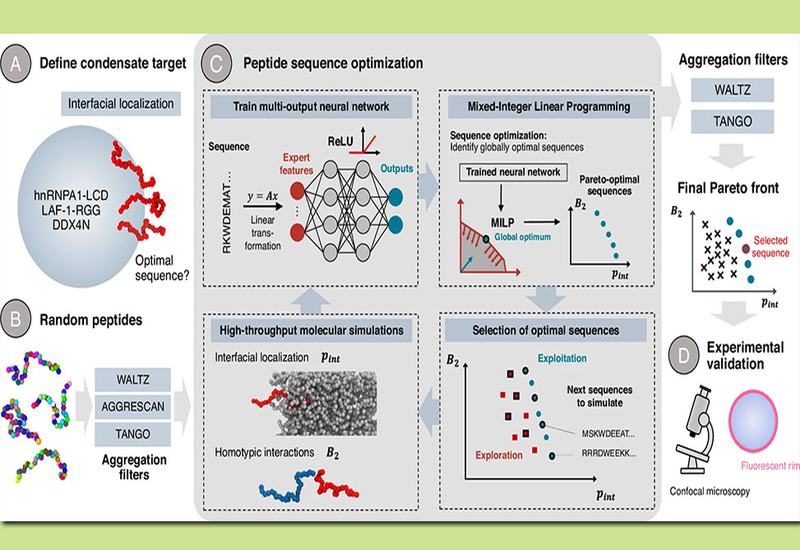
The interface between the dense and dilute phases of a biomolecular condensate is not a passive boundary. It accelerates amyloid formation by hnRNPA1, promotes the liquid-to-solid transition of FUS, and can sustain redox reactions, making it a compelling target for condensate engineering. Classical surfactant design does not translate to this context: both phases contain substantial water and dissolved ions, so the physicochemical contrast that drives molecules to an oil-water interface is largely absent. Designing short peptides compounds the problem further, because fewer interaction sites are available per molecule and the translational-entropy penalty of confining a small molecule to an interface is harder to overcome. Without guiding design rules or a high-throughput screening strategy, the molecular grammar of condensate-interface localization has remained poorly defined.
Researchers in the Arosio Lab at ETH Zurich, published in Nature Communications, built a computational pipeline integrating coarse-grained molecular dynamics, machine learning, and mixed-integer linear programming, MILP, to address this inverse design problem directly. Starting from randomized 30-residue sequences filtered for aggregation propensity, the team scored each candidate on two objectives using the Mpipi force field: the probability of localizing at the condensate interface, quantified via a potential-of-mean-force approach, and a second virial coefficient capturing homotypic self-repulsion. A multi-output neural network trained on those simulation results was embedded into a MILP formulation and solved to global optimality, yielding Pareto-optimal sequences at each active-learning iteration rather than risking the local-optima traps that afflict genetic algorithms. The key mechanistic finding is that the designed peptides adopt a surfactant-like architecture: one tail, enriched in aromatic residues and, for positively charged condensates, arginine, engages the dense phase through π–π and cation–π interactions, while the opposing tail is excluded by a charge-matching mechanism that mirrors the net charge of the scaffold protein.
Confocal microscopy confirmed interfacial localization for peptides designed against three distinct intrinsically disordered regions, validating both the computational predictions and the generalizability of the approach. The peptides also shifted condensate size distributions toward smaller droplets at sub-stoichiometric concentrations without detectably perturbing bulk condensate properties, pointing toward applications in tuning condensate coalescence and surface tension. The pipeline's active-learning architecture and MILP-guaranteed global optimality make it extensible to other condensate targets and design objectives, opening a path toward sequence-specific tools for probing the functional roles of condensate interfaces in cell biology and disease.