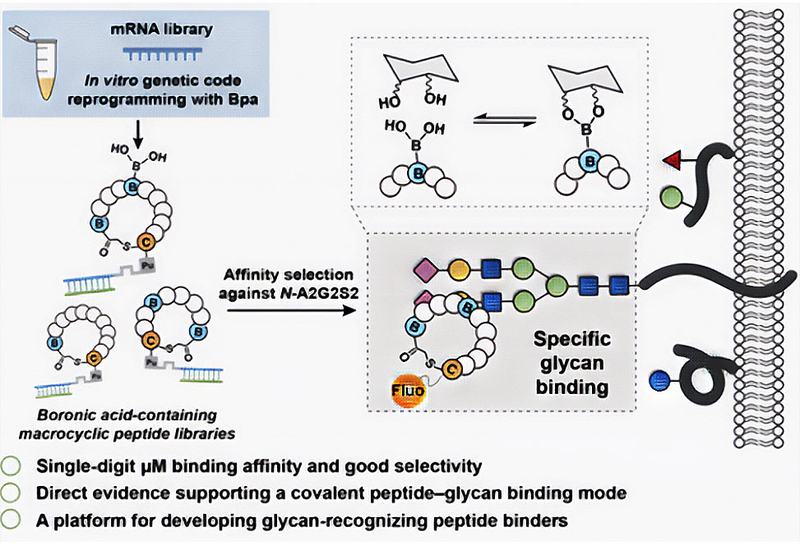
Glycans coat every human cell and their aberrant patterns mark cancers, inflammatory conditions, and metabolic disease, but designing synthetic molecules that bind a defined glycan selectively is genuinely hard. The chemical alphabet of monosaccharides is far narrower than that of amino acids, glycans lack a fixed tertiary structure in solution, and their surfaces offer few handles for specific recognition. Boronic acids can form reversible covalent bonds with cis-diols on glycan residues, but a single boronic acid unit binds in the millimolar range, and the multivalent polymeric scaffolds typically used to boost potency lack the spatial precision needed for selectivity. The sialylated biantennary N-glycan N-A2G2S2, upregulated in hepatocellular carcinoma, makes the challenge concrete: no natural or synthetic binder specific to this glycan was known, leaving it as an unaddressed biomarker target.
Researchers in the Suga Lab at the University of Tokyo, published in J. Am. Chem. Soc., reasoned that macrocyclic peptides, with their conformationally constrained backbones, could present boronic acids to a glycan surface with the geometric precision that flexible polymers cannot. To build such scaffolds, the team used the flexible in vitro translation system to genetically incorporate L-boronophenylalanine, Bpa, at defined positions within thioether-closed macrocyclic peptides, then assembled a library exceeding 1012 members. Screening this library by RaPID selection, which couples the translation system with mRNA display, against immobilized N-A2G2S2 required careful optimization: boronate ester formation is favored at alkaline pH, and noncovalent bead binders obscured true glycan hits until guanidine washes were introduced. Switching to pH 10 ammonium bicarbonate buffer with guanidine washing cleanly enriched peptides forming covalent contacts with the glycan. The lead peptide, A2−17, achieves single-digit micromolar affinity for N-A2G2S2 at physiological pH, with Bpa→Tyr substitution confirming that the boronic acid residue drives binding through reversible boronate ester formation.
The selectivity data, fluorescence microscopy, and flow cytometry results in the paper reveal how sharply A2−17 discriminates N-A2G2S2 from structurally related glycans and how that discrimination translates to recognition of cancer cell surfaces. For peptide scientists, the platform itself is the opening: a generalizable route to sequence-defined, evolvable macrocyclic scaffolds that can be screened against any glycan target, with built-in covalent capture chemistry and a cellular readout ready to deploy.