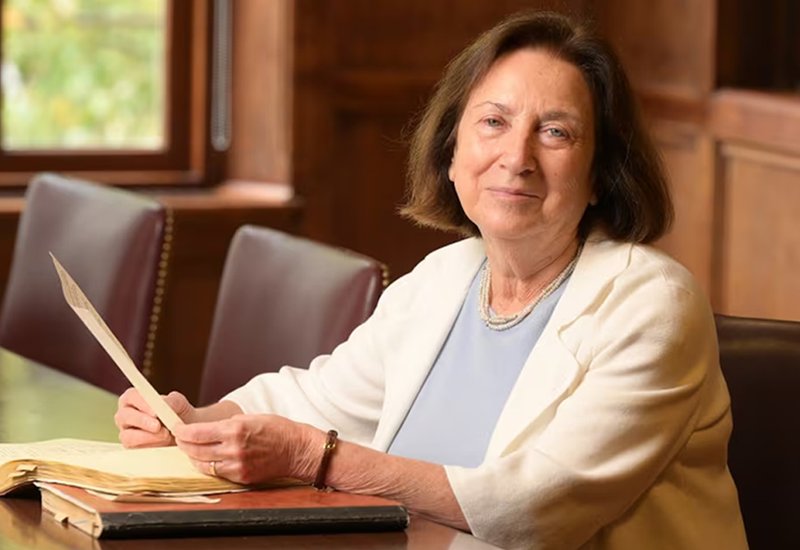
The King Faisal Prize ceremony, the 48th staging of the award, honored Mojsov alongside laureates in the sciences, Arabic language and literature, Islamic studies, and service to Islam. Prince Turki Al-Faisal, acting chairman of the board of trustees of the King Faisal Foundation, and Abdulaziz Alsebail, secretary-general of the King Faisal Prize, presented the 200-gram gold medal, certificate, and accompanying $200,000 award in recognition of work described by the Foundation as having significantly advanced its field and enriched humanity.
Mojsov donated the $200,000 prize money to the Rockefeller University and the Women in Science Initiative.
Mojsov's path to this recognition began in the laboratory of Nobel laureate Bruce Merrifield at The Rockefeller University in the 1970s, where she tackled the then-daunting chemical synthesis of glucagon, a 29-residue peptide hormone that had defeated several leading research groups. Her doctoral work delivered the first crystalline synthetic glucagon produced by solid-phase peptide synthesis, SPPS, and established methodologies robust enough to generate the dozens of analogues needed for rigorous structure-function study.
The first minute of this video is in Arabic, except for certain recognizable terms. This is followed by a professionally produced mini-documentary about Svetlana Mojsov and GLP-1, then the presentation to her surrogate, Professor Emily Wilson. The video concludes with Mojsov's brief but powerful pre-recorded acceptance speech. Our thanks to Anthony W. Czarnik, with the University of Nevada at Reno for the video editing.
Moving to Massachusetts General Hospital in 1983 as Director of the HHMI/MGH Peptide Synthesis Core Facility, Mojsov turned her attention to the then-obscure glucagon-like peptides encoded within the same preproglucagon gene. Working independently, she synthesized the preproglucagon-derived peptides, raised antibodies against each, and developed the radioimmunoassays and chromatographic methods needed to distinguish them in tissue. Her key insight identified the critical cleavage site that releases a truncated form, GLP-1(7-37). She then collaborated with Joel Habener's group at MGH and Gordon Weir at the Joslin Diabetes Center to prove that GLP-1(7-37) was the biologically active, insulinotropic species. Those findings, published in the Journal of Biological Chemistry in 1986 and the Journal of Clinical Investigation in 1987, established the chemical foundation for everything that followed.
The therapies built on that foundation now reach a scale difficult to overstate. With obesity affecting 890 million adults and 160 million children worldwide as of 2022, the GLP-1 medicines Mojsov's chemistry enabled have become among the most consequential metabolic drugs of the modern era. Mojsov is named as co-inventor on the controlling United States patents licensed to Novo Nordisk for Victoza, Ozempic, and Rybelsus, though that formal inventorship required a twelve-year legal effort on her part to establish.
In her acceptance remarks, Mojsov reflected on the long arc from hypothesis to clinical impact, noting that Novo Nordisk developed the long-acting injectable GLP-1 analogs twenty-five years after her original publications. She expressed humility at seeing work that began four decades ago reach the lives of millions of people worldwide.
The King Faisal Prize joins a recent cascade of major honors recognizing Mojsov's foundational role in the GLP-1 story, including the 2023 VinFuture Prize, the 2024 Pearl Meister Greengard Prize, the 2024 Lasker-DeBakey Clinical Medical Research Award, the 2024 Princess of Asturias Award, the 2024 Tang Prize in Biopharmaceutical Sciences, and the 2025 Warren Triennial Prize. Her selection to TIME magazine's 2024 list of the 100 most influential people, and to Nature's 2023 roster of top ten scientific contributors, further marked what the broader scientific community has come to recognize as long-overdue public acknowledgment of a career built around peptide chemistry done with rigor and generosity.
On behalf of the American Peptide Society, I offer Svetlana our warmest congratulations on this recognition. Her work on GLP-1 stands as an example of what careful peptide chemistry, pursued with patience and rigor across decades, can eventually mean for human health. Svetlana has been a generous colleague and mentor to our community for many years, and seeing her honored on this stage brings genuine pride to all of us at the APS. We are fortunate to count her among our members, and we are grateful for the foundation she built for the generations of peptide scientists who have followed her.
Anna Mapp
President
American Peptide Society